



Global exposure risks to PFAS from marine fish consumption
Associate Professor Wenhui QIU and Chair Professor Chunmiao ZHENG from the School of Environmental Science and Engineering at the Southern University of Science and Technology (SUSTech), in collaboration with multiple institutions, have predicted the concentration of PFAS in 212 edible marine fish and systematically assessed the exposure risks through marine fish consumption. Their paper, titled “Risks of Per- and Polyfluoroalkyl Substance Exposure Through Marine Fish Consumption,” has been published in Science.
Per- and polyfluoroalkyl substances (PFAS) are a class of synthetic chemicals widely used in industrial production and consumer goods manufacturing. Due to their persistence in the environment and potential for bioaccumulation through the food chain, PFAS can accumulate in the human body over time, potentially posing health risks.
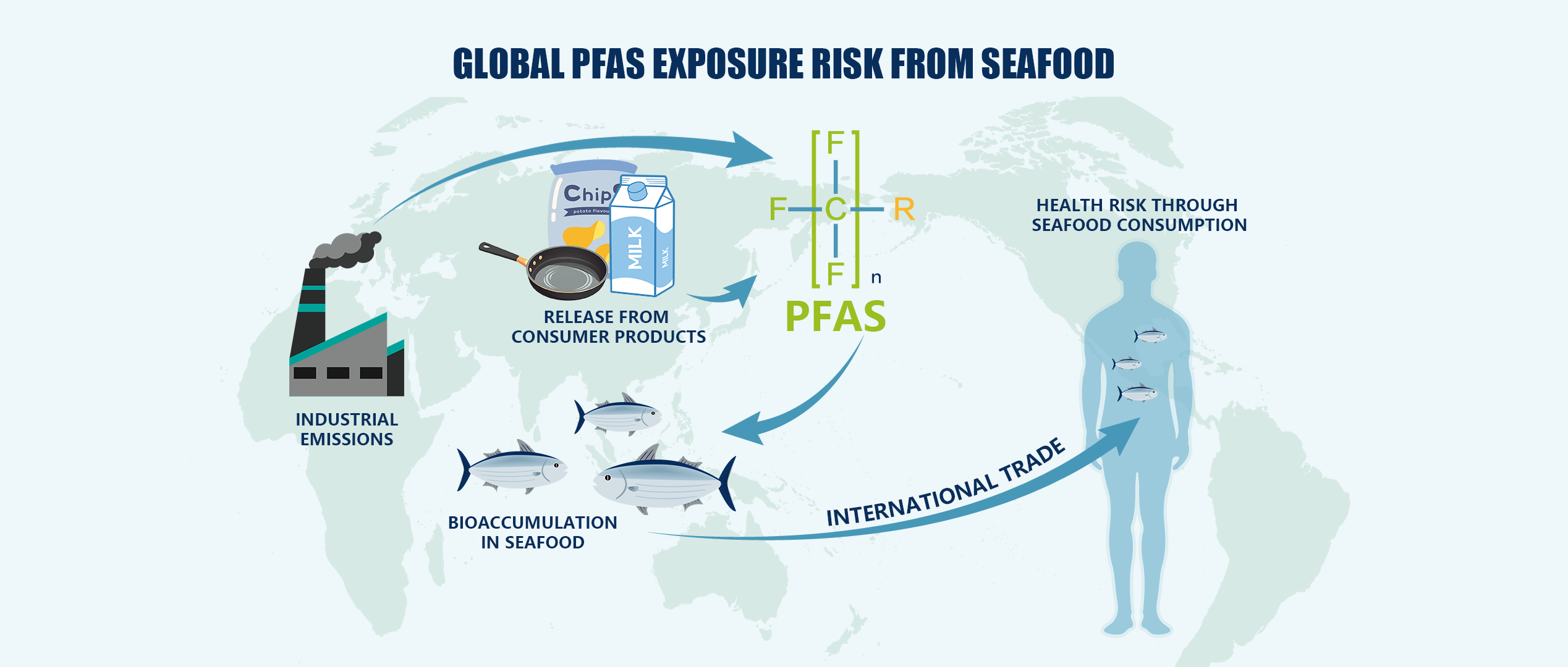
The study integrates 20 years of global marine PFAS monitoring data from 3,126 sites and develops marine food web models to predict the PFAS concentrations in 212 edible marine fish, which account for 99% of the global catch in the studied countries. The PFAS concentrations in these fish are found to be linked to the historical emissions and dilution capacity of the marine environment. Additionally, fish at higher trophic levels exhibit significantly higher concentrations. The study used high performance liquid chromatography–tandem mass spectrometry (HPLC-MS/MS) to analyze actual samples from 33 families, 87 species, and 150 fish samples globally, and the results were used to validate the model predictions from 2010 to 2021. The results indicate that 33% of the data points fall within a twofold error margin, and 94% fall within a tenfold error margin at the sample level, with verification at the trophic level showing similar accuracy (Figure 1).
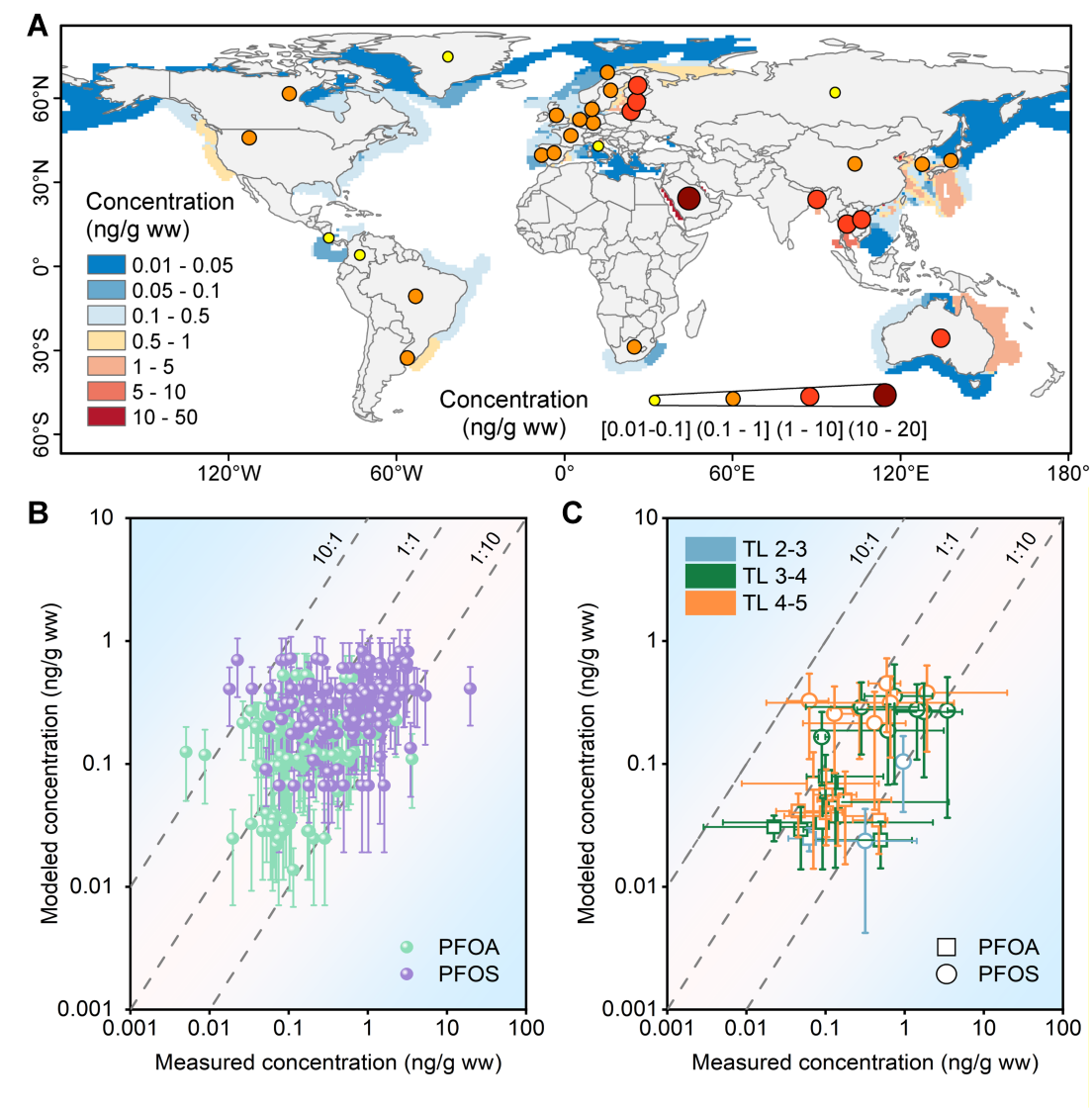
Figure 1. Predicted concentrations of C8-PFAS in marine fish from 2010 to 2021 (A) and model validation (B and C). C8-PFAS refers to the sum of perfluorooctane sulfonate (PFOS) and perfluorooctanoic acid (PFOA).
The study combines global fishing, trade, and population data to assess the estimated daily intake of C8-PFAS through marine fish consumption. It reveals that PFAS are shifting from high-residue regions to low-residue regions along global fish trade pathways. This finding highlights and quantifies the global health risks associated with PFAS exposure through marine fish consumption, particularly for countries and regions that depend on imported seafood, and demonstrates the reshaping potential of global food trade on PFAS exposure patterns (Figure 2).
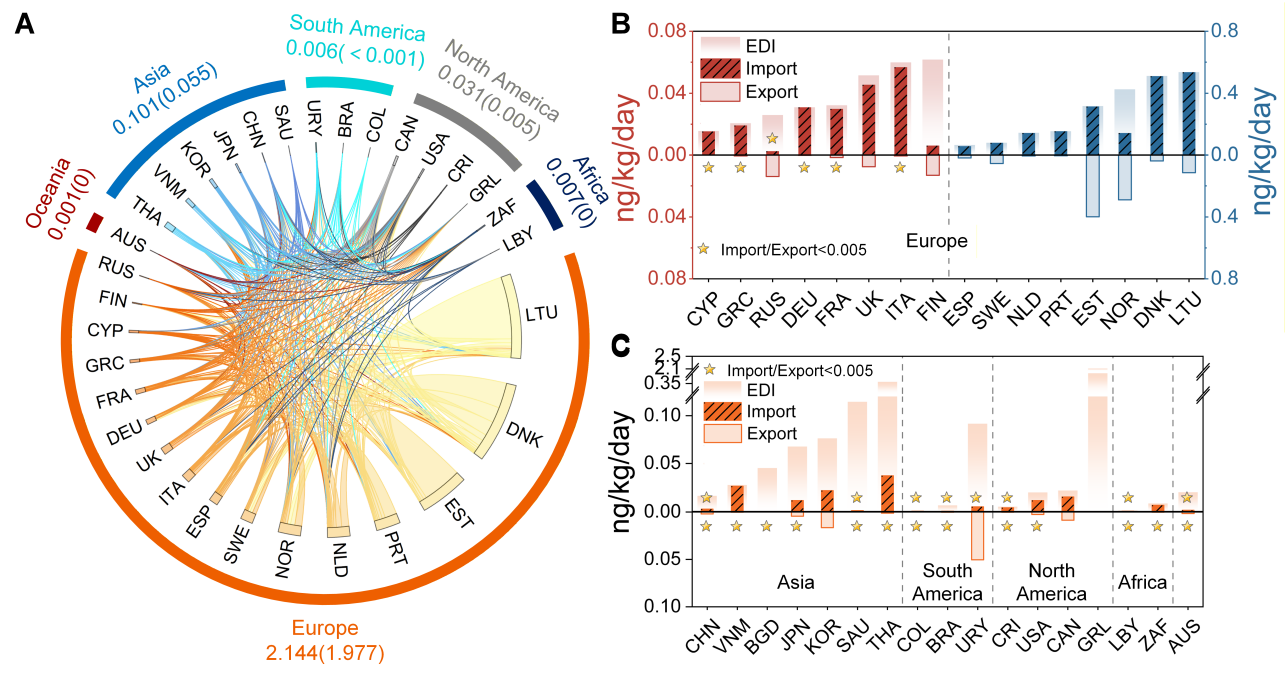
Figure 2. C8-PFAS EDI import pathways among 31 countries (A) and the EDI composition of each country (B and C).
Further analysis shows that longer-chain PFAS, such as perfluorodecanoic acid (PFDA, C10), perfluorononanoic acid (PFNA, C9), and perfluoroundecanoic acid (PFUnDA, C11), exhibit higher bioaccumulation potential. These long-chain PFAS not only increase the PFAS concentration in fish but also raise human exposure levels through consumption. Additionally, the bioaccumulation characteristics of these long-chain PFAS affect reference doses determined by toxicological experiments, leading to more stringent reference doses, thereby posing a substantial but largely overlooked threat to human health. The health risks of these long-chain PFAS require further attention (Figure 3).
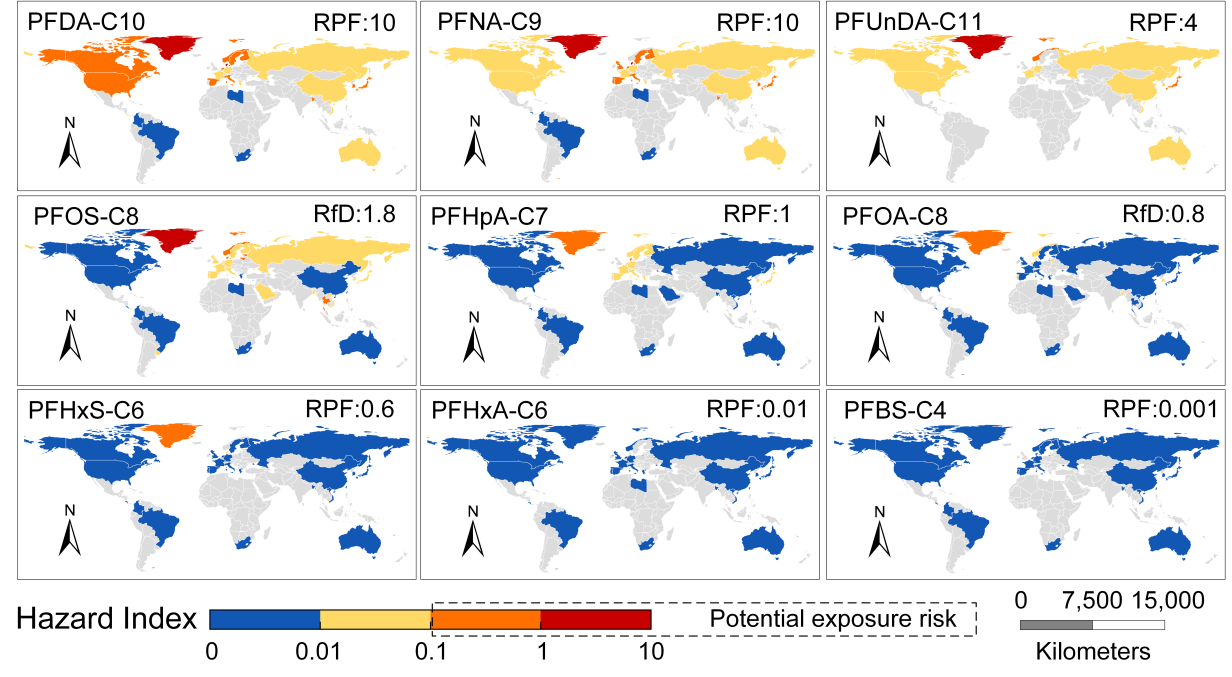
Figure 3. Exposure risk levels of nine PFAS from 2010 to 2021.
The study establishes an innovative research framework, systematically revealing the bioaccumulation dynamics of PFAS in the marine food web and the associated exposure risks to human populations. This framework integrates environmental concentration data, marine food web models, bioaccumulation factors, global fishing statistics, trade networks, and health risk assessments, clearly tracing the complete pathway of PFAS from aquatic environments into fish and subsequently into humans through dietary exposure. The study finds that PFAS exhibit significant biomagnification effects in the marine food web, providing the chemical basis for PFAS accumulation in fish and dietary exposure in humans. Notably, longer-chain PFAS, due to their stronger persistence and bioaccumulation potential, present more prominent ecological health risks globally. This finding clarifies the bioaccumulation differences among various PFAS homologs and their distinct risk profiles, offering key scientific evidence for the development of fisheries management and PFAS regulatory policies.
The Southern University of Science and Technology is the primary institution for this paper, with Associate Professor Wenhui QIU and PhD student Ge Yang as co-first authors. The corresponding authors are Professor Wenhui QIU, Professor Zhaomin DONG (Southeast University), Academician Minghong WU of the Chinese Academy of Sciences (Fuzhou University), and Chair Professor Chunmiao ZHENG (Eastern Institute of Technology).