

© 2026 All Rights Reserved. 粤ICP备14051456号
2021-03-30
View:11
In March 2021, a joint research team led by Professor Jeong Sujong from Seoul National University (SNU) and Professor Chunmiao Zheng from the Southern University of Science and Technology (SUSTech) revealed the impacts of climate change on tea production across China. The study findings were published in the renowned international journal Environmental Research Letters, entitled “Effects of extreme temperature on China’s tea production.” This study, for the first time, quantified the relationships between temperature extremes and tea production in China by integrating multisource datasets and a panel regression model with 21 global climate models, demonstrating the vulnerability of tea production to both cold and heat extremes.
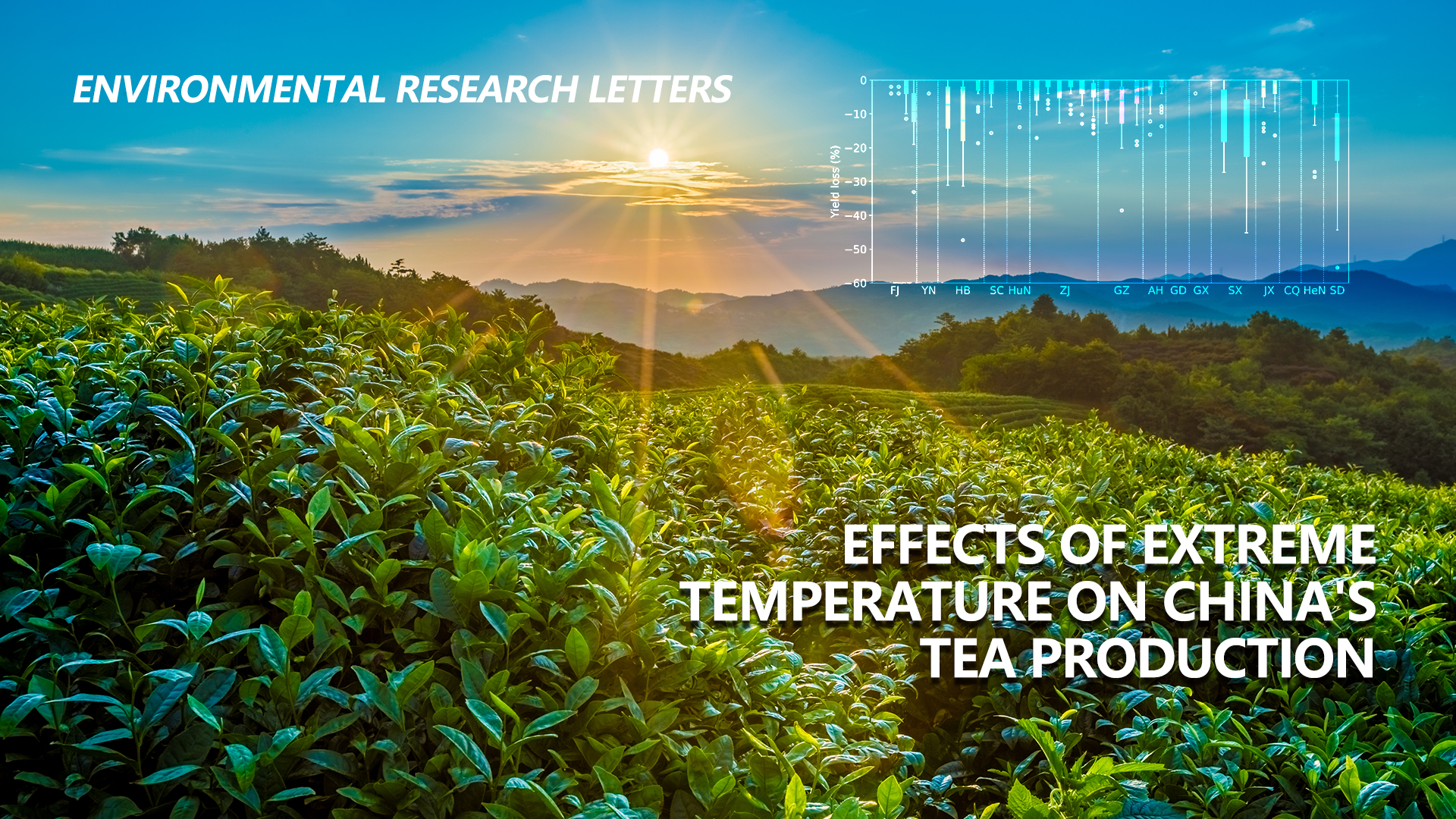
Tea is the second most consumed beverage globally and one of the most important cash crops in developing countries. China as the largest tea-producing country accounts for around 41% of the world’s production in 2016. As a result, tea cultivation is of considerable socio-economic importance for rural development and poverty alleviation. However, the production of tea is susceptible to extreme weather events. Unfavorable weather conditions can be detrimental to tea production and substantially reduce tea yields and quality. Despite the vital importance of tea production in China, research efforts to understand the impacts of climate change on tea production are considerably limited, especially with regards to temperature extremes.
In this study, the joint research team collected a new long-term, fine-resolution, prefecture-scale tea production dataset and merged it with weather data, which covers ~70% of the tea-growing regions in China. The team deployed a classic regression model approach to analyze the nonlinear responses of tea yield to historical weather variability. Subsequently, a total of 21 global climate models were used to estimate future temperature extremes and their consequent impacts on tea yields under the 1.5 °C and 2.0 °C warming scenarios.
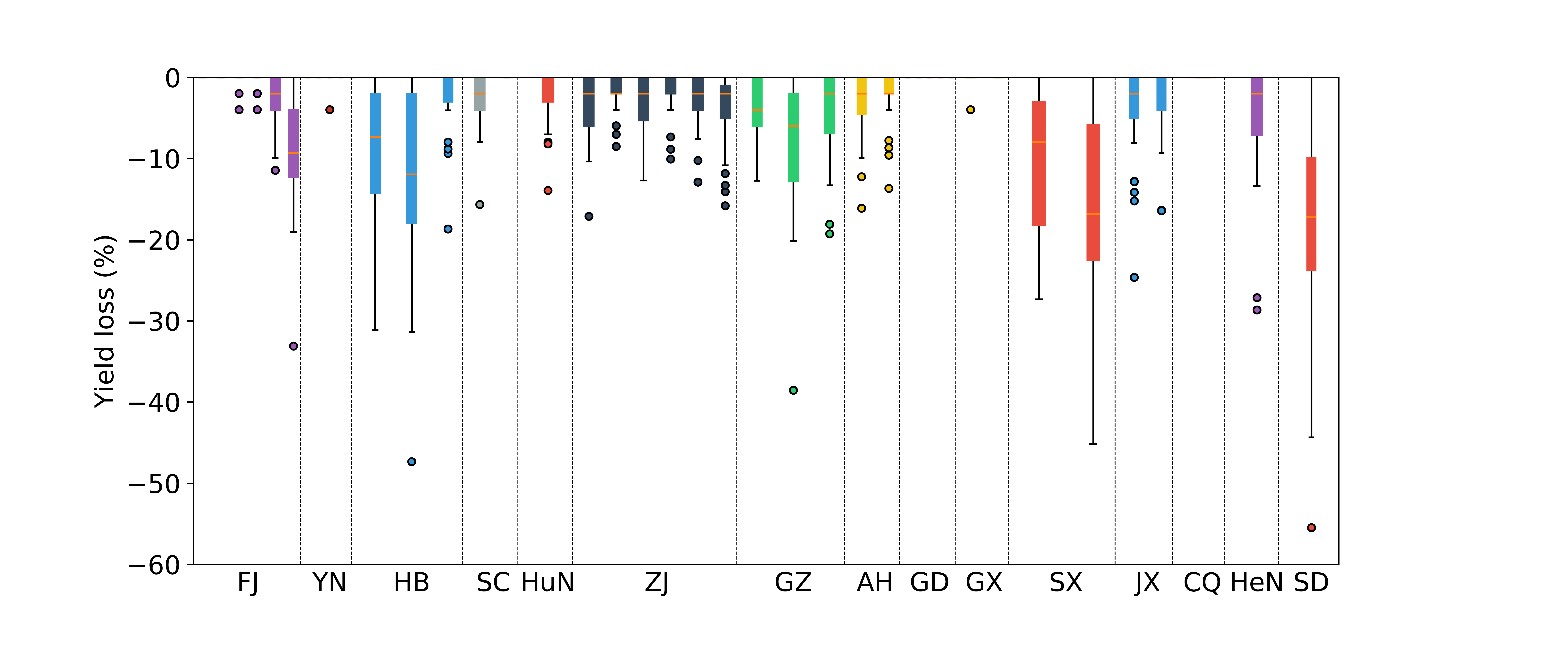
Figure 1. The impact of cold waves in different provinces of China on tea production
The study uncovers that in the present climate (1990-2016), dominating cold extremes influence more than 50% of China’s tea production, with a maximum of 56.3% reduced annual production. In the near future, the team predicts positive net impacts of climate change on tea yield in all study regions at both the 1.5 °C and 2.0 °C global warming levels. However, new areas of yield reduction by intensified heat extremes will emerge at the Yangtze River and southern China regions. This study provides scientific evidence to mitigate negative extreme temperature effects on China’s tea industry and guidelines to adapt tea production to climate change.
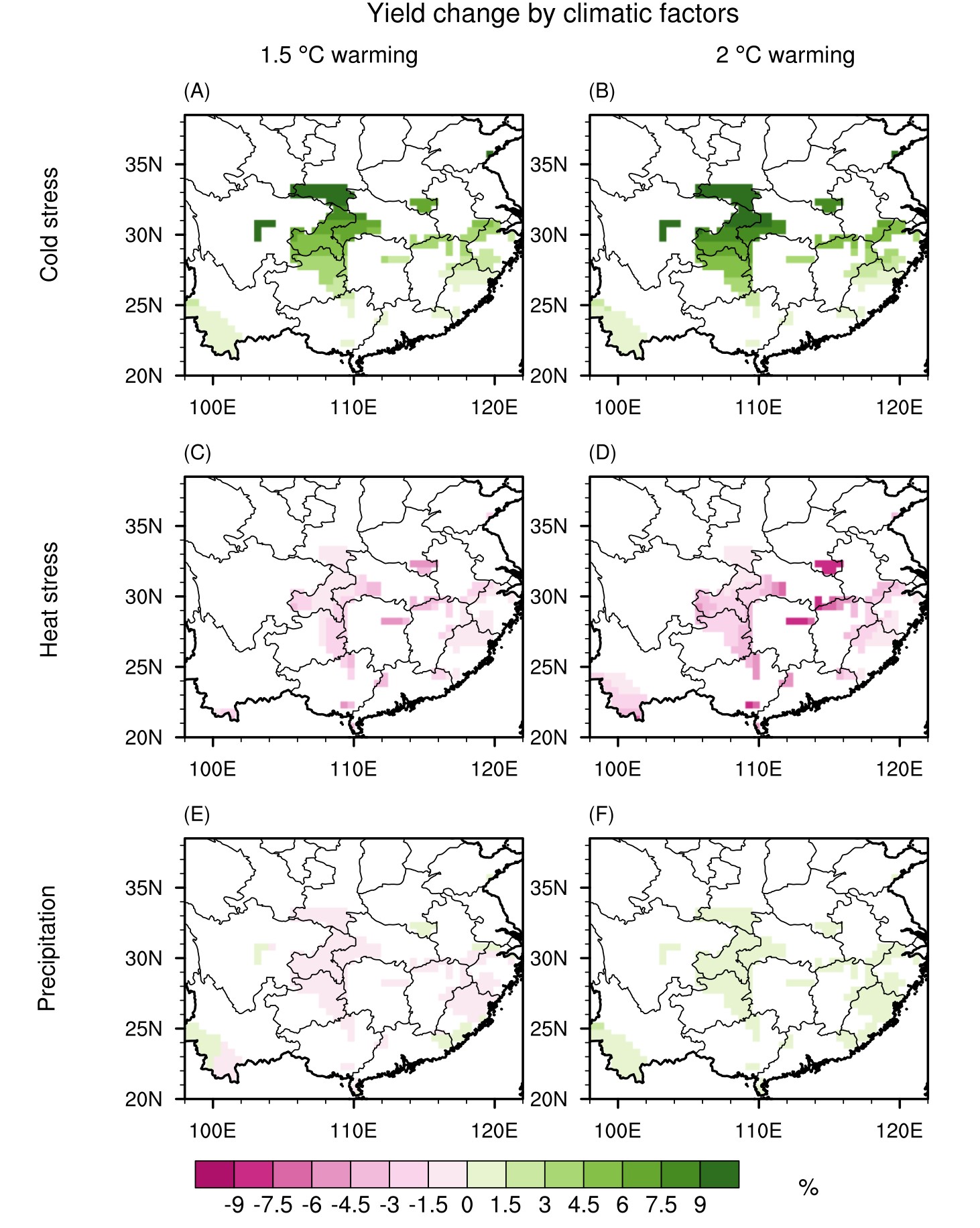
Figure 2. The impact of cold wave, high temperature, and precipitation on tea production under the scenarios of 1.5°C and 2°C temperatures in the future
The joint study was completed by Professor Chunmiao Zheng’s research group at SUSTech and Professor Jeong Sujong’s research group at SNU. Professor Chunmiao Zheng and Professor Jeong Sujong are the corresponding authors. Dr. Yulin Yan from Professor Jeong Sujong’s team is the first author. SUSTech Professor Junguo Liu and former members Dr. Chang-Eui Park and Dr. Jaewon Joo from Professor Chunmiao Zheng’s laboratory contributed to the study. This work was supported by the National Key R&D Program of China and other projects.
Paper link: https://iopscience.iop.org/article/10.1088/1748-9326/abede6/meta
2026-03-10
2026-09-08
A delegation of 13 students from Southern University of Science and Technology (SUSTech), Zhejiang University and the University of Science and Technology of China (USTC), accompanied by four SUSTech faculty members including including two affiliated with the State Key Laboratory of Soil Pollution Control and Safety, concluded a 12-day summer school at Flinders University in August, 2026, hosted by the University’s National Centre for Groundwater Research and Training (NCGRT).Throughout the program, the students participated in a wide range of educational activities covering water resources, environmental health, groundwater modeling, managed aquifer recharge, salinity management, mining sites management, virtual reality hydrology, and nature-based solutions for surface water, groundwater and soil pollution.A highlight of the visit was a series of field trips showcasing South Australia’s unique natural environments. These included an overnight excursion to a global showcase of integrated surface and groundwater management exemplified by the Murray-Darling Basin. Visits to the St Kilda Mangroves highlighted ecohydrological approaches to coastal mangrove conservation. While Hallett Cove featured the most famous glacial striation on pre-Cambrian rocks. Happy Valley Reservoir, Oaklands Wetland, and Port Willunga Beach, with their wildlife, water management and well-exposed sedimentary rock formations, left strong impressions on our students. Students also attended research seminars and explored Flinders University’s teaching and research facilities.This summer school provided an excellent opportunity for students to engage with Flinders University staff, students, and researchers, experience Australian approaches to soil and groundwater pollution control and safety research, and strengthen the institutional ties between SUSTech and Flinders University, while fostering international connections and cross-cultural learning. The visit was made possible through a combination of support provided by SUSTech and the Fundamental and Interdisciplinary Disciplines Breakthrough Plan of the Ministry of Education of China(JYB2025XDXM909).During the visit, Chair Professor Yan ZHENG from SUSTech delivered a research seminar on arsenic detection in the developed and developing world. Flinders University noted that its academic community was privileged to learn from her expertise.SUSTech expresses its gratitude for the incredible partnership with Flinders University at the conclusion of the program.
2026-04-22
On April 22, the Frontiers Planet Prize announced its list of 25 National Champions for 2026. Hong WANG, a 2025 graduate of the School of Environmental Science and Engineering at the Southern Universi
2026-04-20
On the morning of April 17, 2026, a delegation from Flinders University (Australia), led by Professor Colin Stirling, President of Flinders University, visited the Southern University of Science and T
2026-04-08
Hydrological models are foundational tools for water resource management, agricultural planning, flood and drought mitigation, and ecosystem protection. A long-standing challenge in hydrology is devel
 |