

© 2026 All Rights Reserved. 粤ICP备14051456号
2021-04-12
View:13
Recently, the team led by Professor Zuotai Zhang of the School of Environmental Sciences and Engineering at the Southern University of Science and Technology (SUSTech) has made significant progress in the advanced treatment of wastewater. The results have been published in the highly influential academic journal Environmental Science & Technology, entitle “Atomically Dispersed Cobalt Sites on Graphene as Efficient Periodate Activators for Selective Organic Pollutant Degradation.”
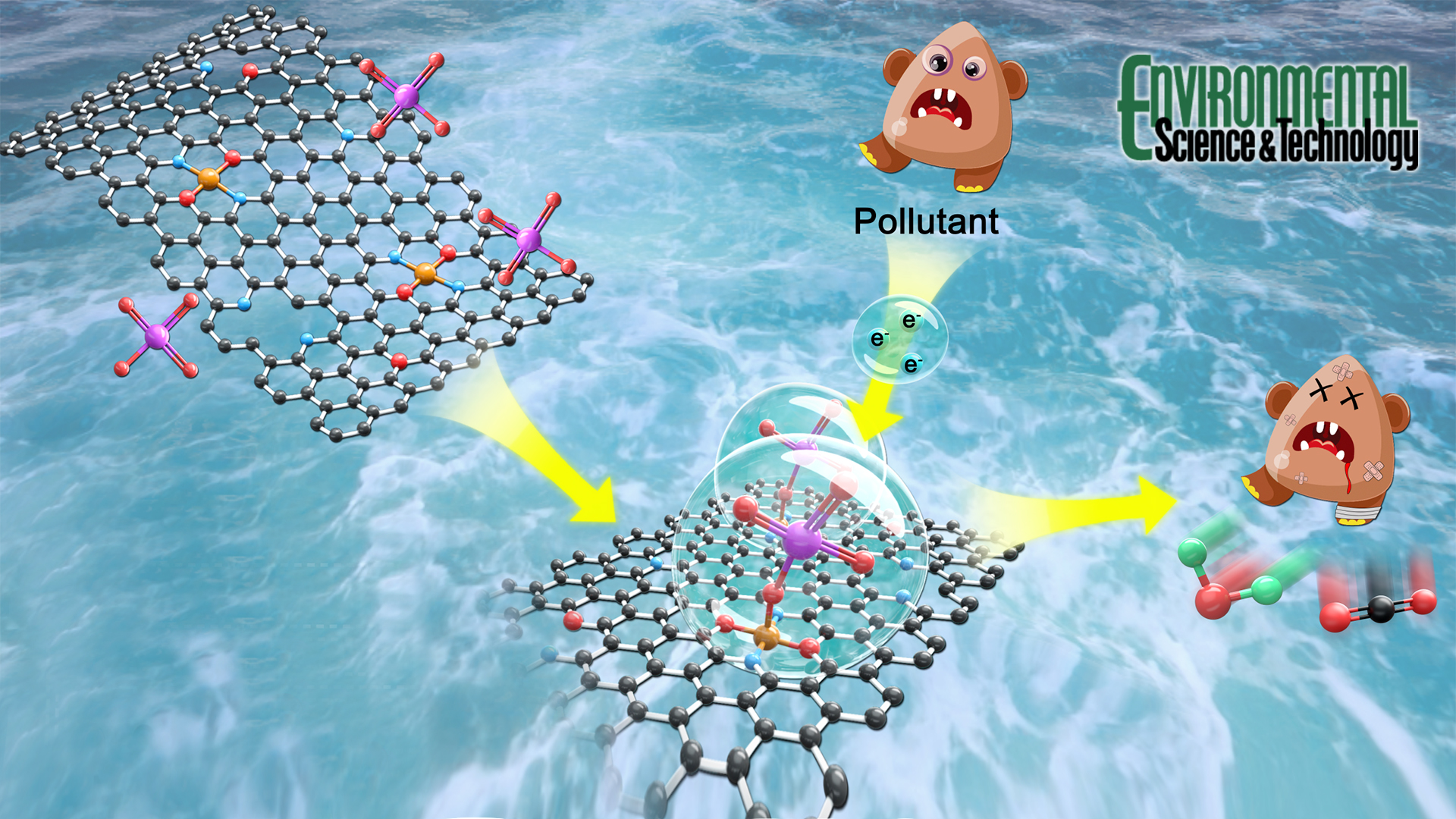
In recent years, non-radical pathway-based advanced oxidation technologies for the decontamination of recalcitrant organic pollutant has gained significant research interests. Compared with the conventional free-radical species-based oxidation process, the non-radical oxidation process possesses huge advantages in practical applications.
Firstly, non-radical species such as singlet oxygen (1O2) normally display an excellent selectivity toward electron-rich pollutants or bacteria. Secondly, the non-radical-based advanced oxidation process shows strong resistance to external interference, that is, it is less affected by water pH conditions and coexisting background substances (e.g., inorganic anions and natural organic matter). Lastly, in the process of non-radical oxidation, the utilization efficiency of oxidants is much higher, which can reduce the overall cost of water treatment technology. Therefore, it is of great significance to develop novel and effective advanced oxidation technology systems based on the non-radical oxidation pathway.
In this work, the team developed a novel non-radical-based advanced oxidation technology using a single-cobalt-atom activator catalyzed periodate oxidation process. According to their results, the single-cobalt-sites on carbon carriers effectively activated periodate to selectively degrade organic pollutants through an electron-transfer-based non-radical pathway.
Based on the experimental and theoretical data, it was proposed that the periodate molecule was first adsorbed on the activator surface to produce a metastable activator-periodate complex that possessed a high oxidation potential. Then, the above-formed complex extracted electrons from the aromatic organic pollutants such as phenol, 4-chlorophenol, and rhodamine B thereby resulted in pollutant degradation and mineralization. The developed system possesses a wide pH adaptability and strong resistances to external interference in the complex water matrix, therefore opening new directions to design high-performance non-radical oxidation technology for wastewater treatment.
Yangke Long, a postdoctoral fellow from the School of Environmental Sciences and Engineering at SUSTech, is the first author of the paper. Professor Zuotai Zhang from SUSTech is the corresponding author.
This work was supported by the China Postdoctoral Science Foundation, National Natural Science Foundation of China (NSFC), Shenzhen Science and Technology Innovation Committee, and the Shenzhen Peacock Plan Project.
Paper link: https://pubs.acs.org/doi/10.1021/acs.est.0c07794
2026-03-10
2026-09-08
A delegation of 13 students from Southern University of Science and Technology (SUSTech), Zhejiang University and the University of Science and Technology of China (USTC), accompanied by four SUSTech faculty members including including two affiliated with the State Key Laboratory of Soil Pollution Control and Safety, concluded a 12-day summer school at Flinders University in August, 2026, hosted by the University’s National Centre for Groundwater Research and Training (NCGRT).Throughout the program, the students participated in a wide range of educational activities covering water resources, environmental health, groundwater modeling, managed aquifer recharge, salinity management, mining sites management, virtual reality hydrology, and nature-based solutions for surface water, groundwater and soil pollution.A highlight of the visit was a series of field trips showcasing South Australia’s unique natural environments. These included an overnight excursion to a global showcase of integrated surface and groundwater management exemplified by the Murray-Darling Basin. Visits to the St Kilda Mangroves highlighted ecohydrological approaches to coastal mangrove conservation. While Hallett Cove featured the most famous glacial striation on pre-Cambrian rocks. Happy Valley Reservoir, Oaklands Wetland, and Port Willunga Beach, with their wildlife, water management and well-exposed sedimentary rock formations, left strong impressions on our students. Students also attended research seminars and explored Flinders University’s teaching and research facilities.This summer school provided an excellent opportunity for students to engage with Flinders University staff, students, and researchers, experience Australian approaches to soil and groundwater pollution control and safety research, and strengthen the institutional ties between SUSTech and Flinders University, while fostering international connections and cross-cultural learning. The visit was made possible through a combination of support provided by SUSTech and the Fundamental and Interdisciplinary Disciplines Breakthrough Plan of the Ministry of Education of China(JYB2025XDXM909).During the visit, Chair Professor Yan ZHENG from SUSTech delivered a research seminar on arsenic detection in the developed and developing world. Flinders University noted that its academic community was privileged to learn from her expertise.SUSTech expresses its gratitude for the incredible partnership with Flinders University at the conclusion of the program.
2026-04-22
On April 22, the Frontiers Planet Prize announced its list of 25 National Champions for 2026. Hong WANG, a 2025 graduate of the School of Environmental Science and Engineering at the Southern Universi
2026-04-20
On the morning of April 17, 2026, a delegation from Flinders University (Australia), led by Professor Colin Stirling, President of Flinders University, visited the Southern University of Science and T
2026-04-08
Hydrological models are foundational tools for water resource management, agricultural planning, flood and drought mitigation, and ecosystem protection. A long-standing challenge in hydrology is devel
 |