

© 2026 All Rights Reserved. 粤ICP备14051456号
2023-04-27
View:22
Surface ozone concentrations have been rising over most parts of China, posing great risks to public health. At present, the forecasts of surface ozone concentrations are still highly uncertain, and one of the sources of that uncertainty is the uncertainty associated with weather forecasts. However, the impacts of the uncertainty of weather forecasts on surface ozone forecasts have not yet been quantified in daily operations.
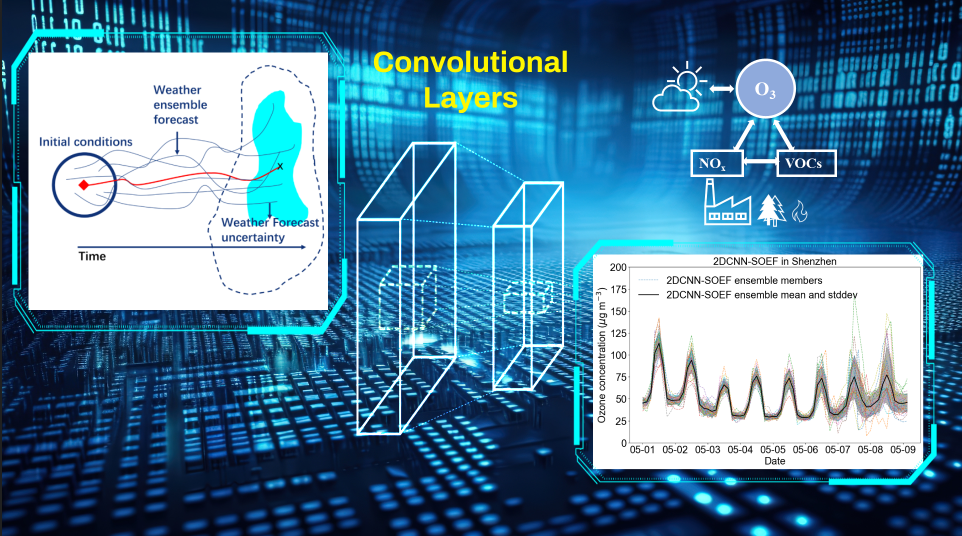
Professor Tzung-May Fu’s research group from the School of Environmental Science and Engineering at the Southern University of Science and Technology (SUSTech) and National Center for Applied Mathematics Shenzhen (NCAMS) recently published an article that introduces the development of a deep-learning ozone ensemble forecast model and its application in the predictability analysis of surface ozone pollution in Shenzhen.
Their work, entitled “Deep Learning-Based Ensemble Forecasts and Predictability Assessments for Surface Ozone Pollution,” has been published in Geophysical Research Letters, a top journal in the field of Earth Science.
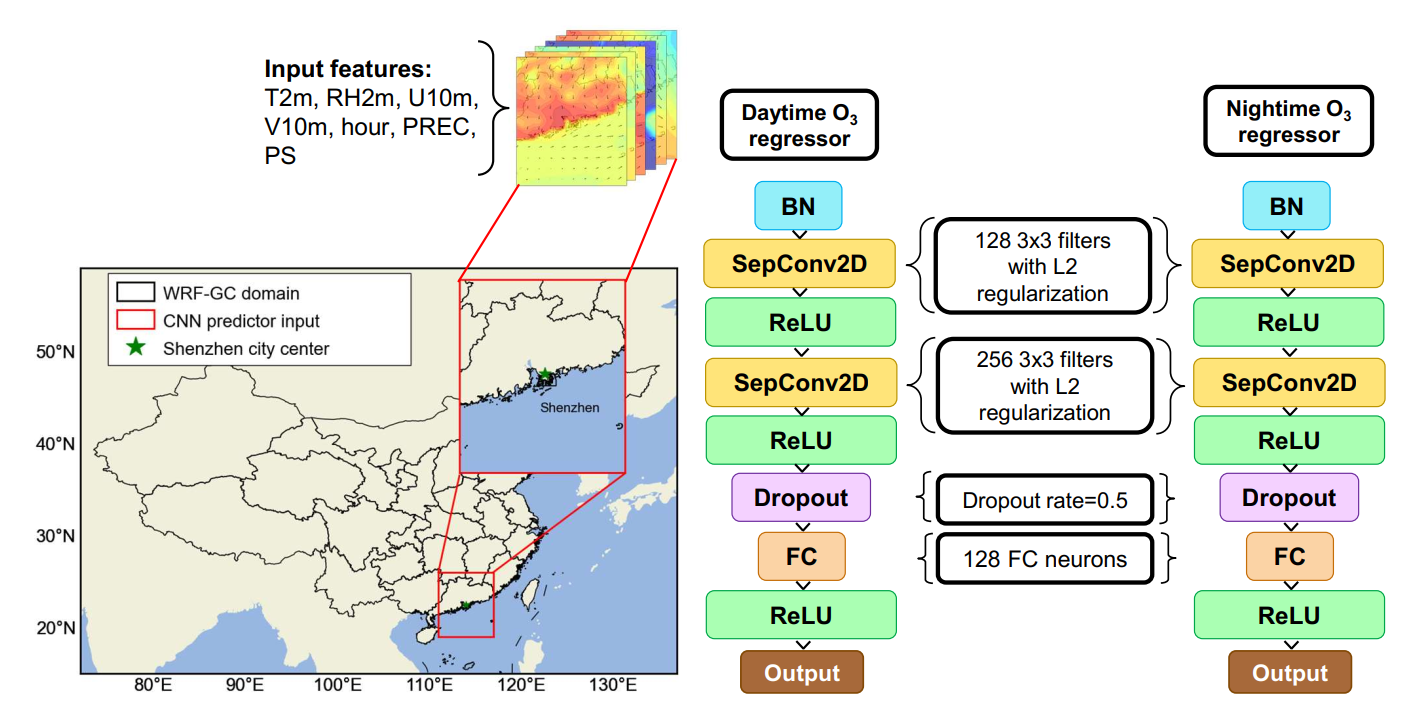
Figure 1. Schematic of the 2DCNNs trained with WRF-GC simulated meteorological fields and surface ozone concentrations.
Using the 2-dimensional convolutional neural network (2DCNN) framework, the researchers developed a deep-learning surface ozone ensemble forecast system (2DCNN-SOEF). The 2DCNN-SOEF system was trained with simulation outputs from the WRF-GC regional meteorology-chemistry coupled model, developed by Prof. Fu’s group. The 2DCNN-SOEF used the spatial distributions of meteorological variables as inputs to predict the surface ozone response to meso- and synoptic scale meteorology in Shenzhen. Figure 2 shows the 2DCNN-SOEF’s 24-hour and 72-hour forecasts of surface ozone concentrations in Shenzhen during the summers of 2019 and 2021. The correlation coefficients between the observations and forecasts exceeded 0.7.
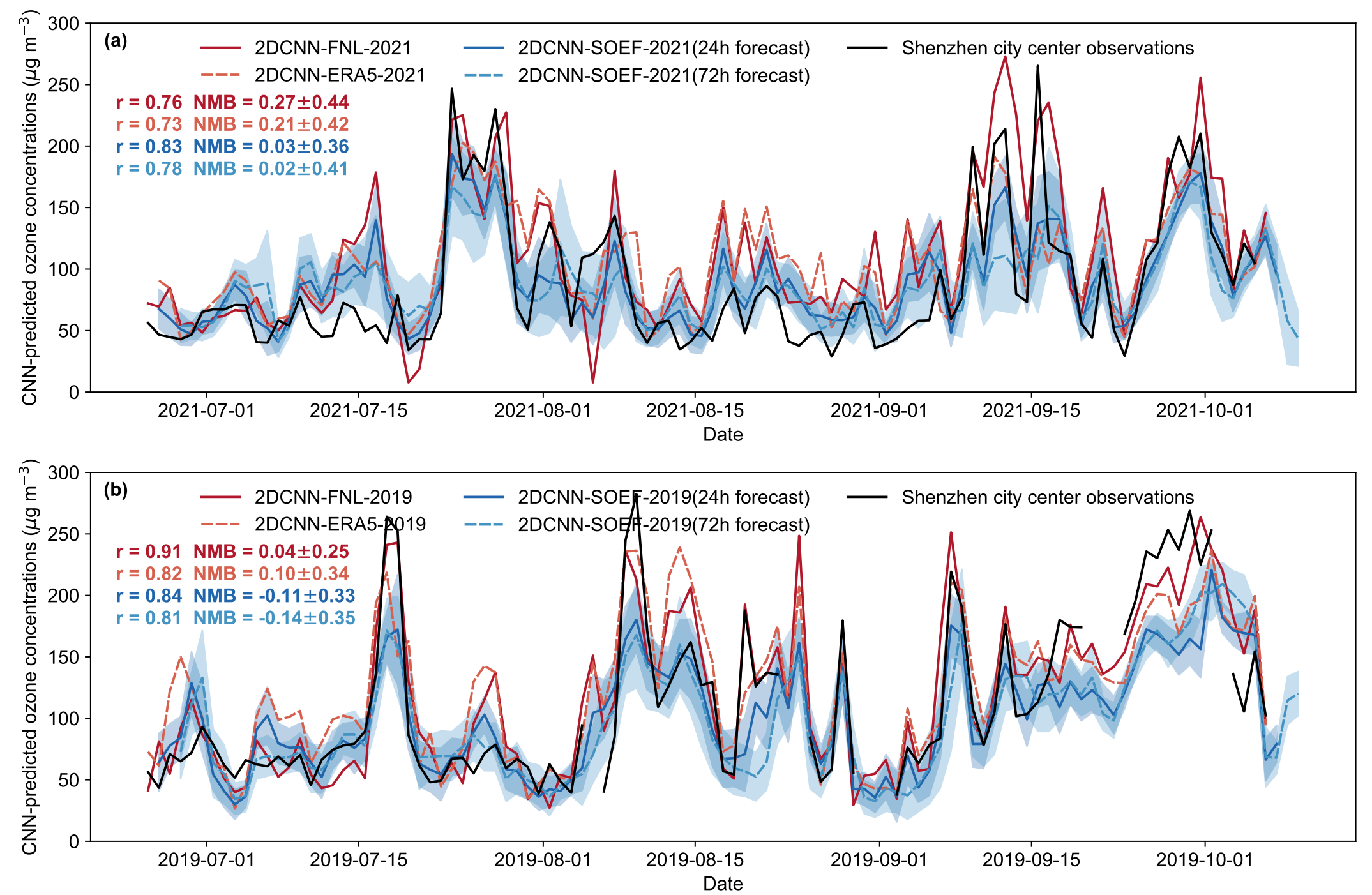
Figure 2. Surface ozone concentrations in Shenzhen at 14:00 local time from the 2DCNN hindcasts and forecasts (color-coded) for the summers of (a) 2021 and (b) 2019.
The team used the 2DCNN-SOEF to quantify the impacts on ozone forecasts due to the uncertainty of weather forecasts using a 50-member ensemble weather forecast. During ozone exceedance events in Shenzhen, uncertainties associated with weather forecasts led to >38% (9.7 μg m-3) of the forecast errors in hourly surface ozone concentrations. The differences between members of the ensemble weather forecasts led to >24% (6.1 μg m-3) of hourly ozone forecast errors.
These ozone forecast errors were driven by uncertainties in weather forecast and were the predictability limit of surface ozone. These errors cannot be eliminated by improvements in the atmospheric chemical mechanisms and the emission inventories in numerical models.
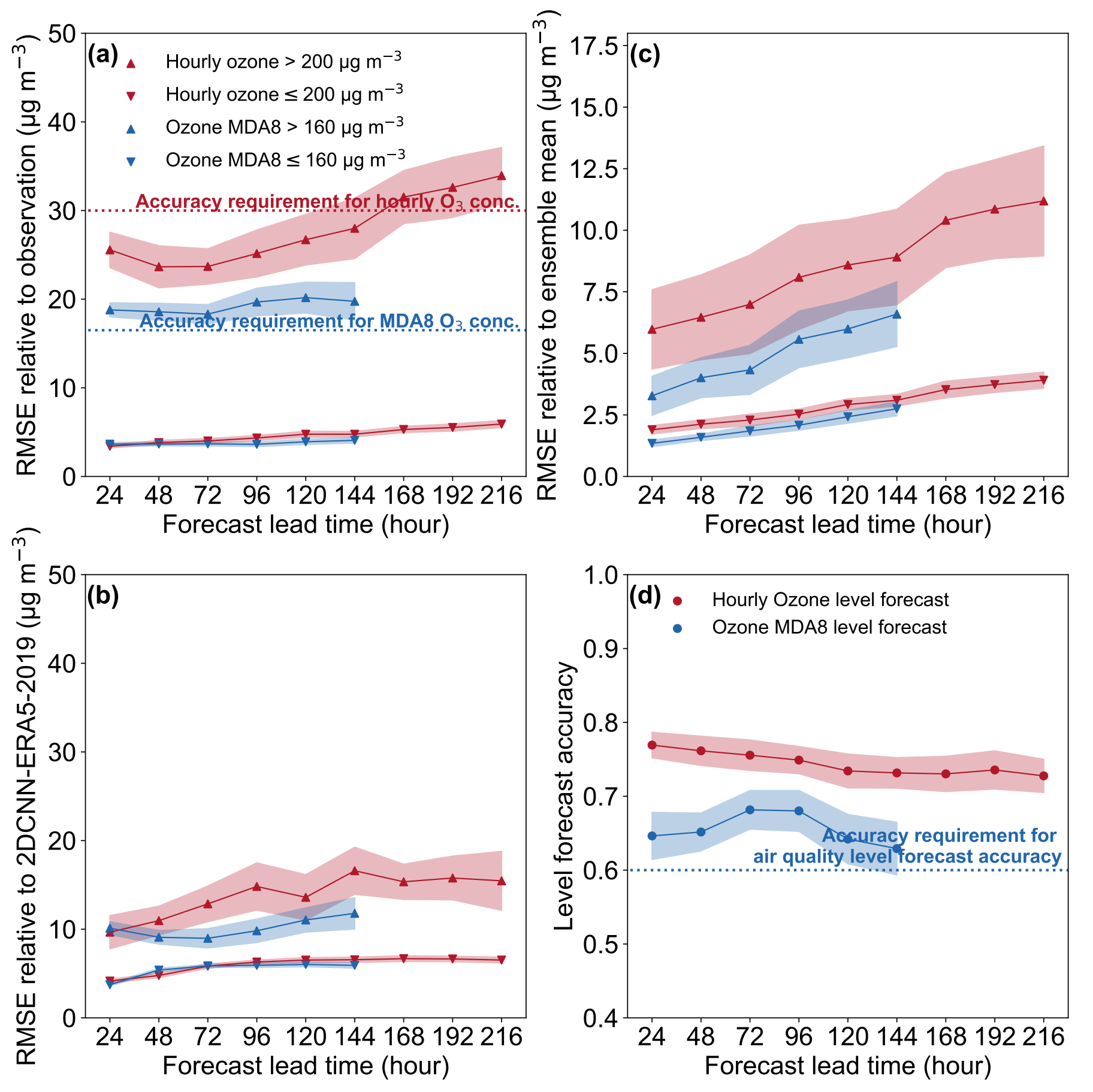
Figure 3. The 2DCNN-SOEF’s performance for hourly (red) and MDA8 (blue) ozone concentrations during the 2019 ozone season as a function of forecast lead time.
The 2DCNN-SOEF forecast performance was comparable to that of regional air quality models and was more time-efficient: a 9-day, 30-member ozone ensemble forecast can be completed within one day. In addition, the 2DCNN-SOEF quantified ozone forecast uncertainty and ozone exceedance probability to better inform air quality management.
The deep learning ensemble forecast framework developed in this study can be extended to the forecasts of other meteorology-sensitive environment risks, providing timely probability forecasts for any location in the world.
Dr. Aoxing Zhang, a postdoctoral researcher of the School of Environmental Science and Engineering at SUSTech, is the first author of this paper. Prof. Tzung-May Fu of SUSTech and NCAMS is the corresponding author.
This research was supported by the Guangdong Basic and Applied Basic Research Foundation, Shenzhen Key Laboratory of Precision Measurement and Early Warning Technology for Urban Environmental Health Risks, Shenzhen Science and Technology Innovation Commission, Shenzhen Science and Technology Program, and the Guangdong Province Major Talent Program. The computing resources were provided by the Center for Computational Science and Engineering at SUSTech.
Paper link: https://agupubs.onlinelibrary.wiley.com/doi/full/10.1029/2022GL102611
2026-03-10
2026-09-08
A delegation of 13 students from Southern University of Science and Technology (SUSTech), Zhejiang University and the University of Science and Technology of China (USTC), accompanied by four SUSTech faculty members including including two affiliated with the State Key Laboratory of Soil Pollution Control and Safety, concluded a 12-day summer school at Flinders University in August, 2026, hosted by the University’s National Centre for Groundwater Research and Training (NCGRT).Throughout the program, the students participated in a wide range of educational activities covering water resources, environmental health, groundwater modeling, managed aquifer recharge, salinity management, mining sites management, virtual reality hydrology, and nature-based solutions for surface water, groundwater and soil pollution.A highlight of the visit was a series of field trips showcasing South Australia’s unique natural environments. These included an overnight excursion to a global showcase of integrated surface and groundwater management exemplified by the Murray-Darling Basin. Visits to the St Kilda Mangroves highlighted ecohydrological approaches to coastal mangrove conservation. While Hallett Cove featured the most famous glacial striation on pre-Cambrian rocks. Happy Valley Reservoir, Oaklands Wetland, and Port Willunga Beach, with their wildlife, water management and well-exposed sedimentary rock formations, left strong impressions on our students. Students also attended research seminars and explored Flinders University’s teaching and research facilities.This summer school provided an excellent opportunity for students to engage with Flinders University staff, students, and researchers, experience Australian approaches to soil and groundwater pollution control and safety research, and strengthen the institutional ties between SUSTech and Flinders University, while fostering international connections and cross-cultural learning. The visit was made possible through a combination of support provided by SUSTech and the Fundamental and Interdisciplinary Disciplines Breakthrough Plan of the Ministry of Education of China(JYB2025XDXM909).During the visit, Chair Professor Yan ZHENG from SUSTech delivered a research seminar on arsenic detection in the developed and developing world. Flinders University noted that its academic community was privileged to learn from her expertise.SUSTech expresses its gratitude for the incredible partnership with Flinders University at the conclusion of the program.
2026-04-22
On April 22, the Frontiers Planet Prize announced its list of 25 National Champions for 2026. Hong WANG, a 2025 graduate of the School of Environmental Science and Engineering at the Southern Universi
2026-04-20
On the morning of April 17, 2026, a delegation from Flinders University (Australia), led by Professor Colin Stirling, President of Flinders University, visited the Southern University of Science and T
2026-04-08
Hydrological models are foundational tools for water resource management, agricultural planning, flood and drought mitigation, and ecosystem protection. A long-standing challenge in hydrology is devel
 |