

© 2026 All Rights Reserved. 粤ICP备14051456号
2023-10-07
View:21
Atmospheric deposition of organic nitrogen (ON) plays a crucial role in the global nitrogen cycle. Surface measurements showed that 2% to 70% of the local atmospheric deposition flux of total nitrogen was organic. However, previous models have largely neglected the spatial and chemical variations of atmospheric ON, leading to inadequate assessment of its global impacts.
Professor Tzung-May Fu’s research group from the School of Environmental Science and Engineering at the Southern University of Science and Technology (SUSTech) and scientists from the Hong Kong University of Science and Technology (HKUST) recently collaborated to quantify the global budget of atmospheric organic nitrogen (ON) aerosol and its contribution to the global atmospheric nitrogen (N) deposition flux.
Their paper, entitled “Dissecting the contributions of organic nitrogen aerosols to global atmospheric nitrogen deposition and implications for ecosystems”, was published in National Science Review, a leading multidisciplinary scientific journal.
The researchers developed a comprehensive global model of atmospheric gaseous and particulate ON, incorporating the latest knowledge on emissions and secondary formations. Their simulated surface concentrations of atmospheric particulate ON (ONp) were highly consistent with global observations, a feat that had not been achieved previously (Figure 1). Additionally, their simulated atmospheric deposition flux aligned with global observations within an order of magnitude (Figure 2).
Prof. Fu’s group estimated that the global atmospheric ON deposition was 26 Tg N yr-1. The majority of this deposition (23 Tg N yr-1) occurred in the form of ON aerosol and accounted for 19% of the global atmospheric total N deposition (124 Tg N yr-1). The main sources of ON aerosols were wildfires, ocean emissions, and secondary formation (Figure 3).
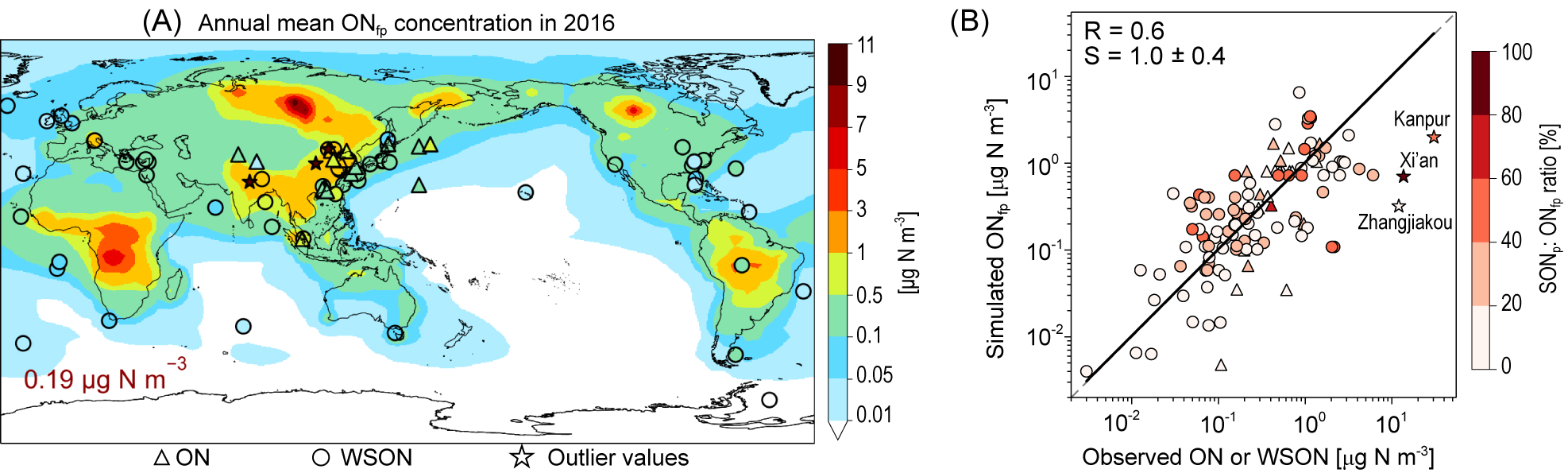
Figure 1. Observed and simulated global annual mean surface concentrations of atmospheric ON aerosols
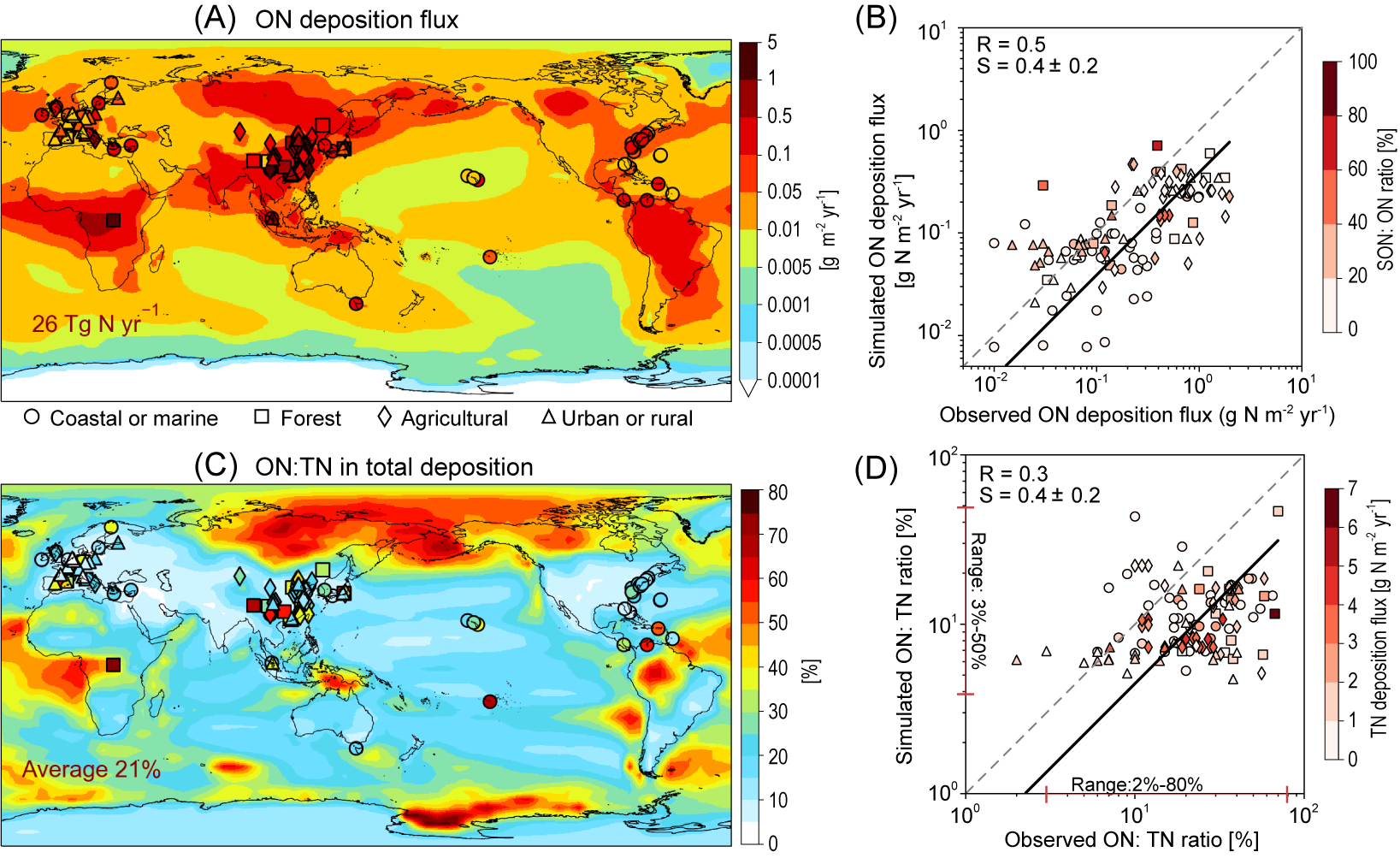
Figure 2. Observed and simulated atmospheric ON deposition fluxes and the ratios of ON versus total nitrogen (TN) in atmospheric deposition fluxes
The scientists showed that the deposition of ON aerosol from the atmosphere is a crucial external source of nitrogen to nitrogen-limited ecosystems worldwide, such as the boreal forests, tundras, and the Arctic Ocean. In a future warming climate, wildfires will likely become more frequent and intense. Climate warming will also lead to surface ocean stratification, making atmospheric ON deposition an increasingly important source of nitrogen to these ecosystems. Their research highlighted the need to better understand the environmental impacts of atmospheric ON aerosol and how those impacts respond to climate change.
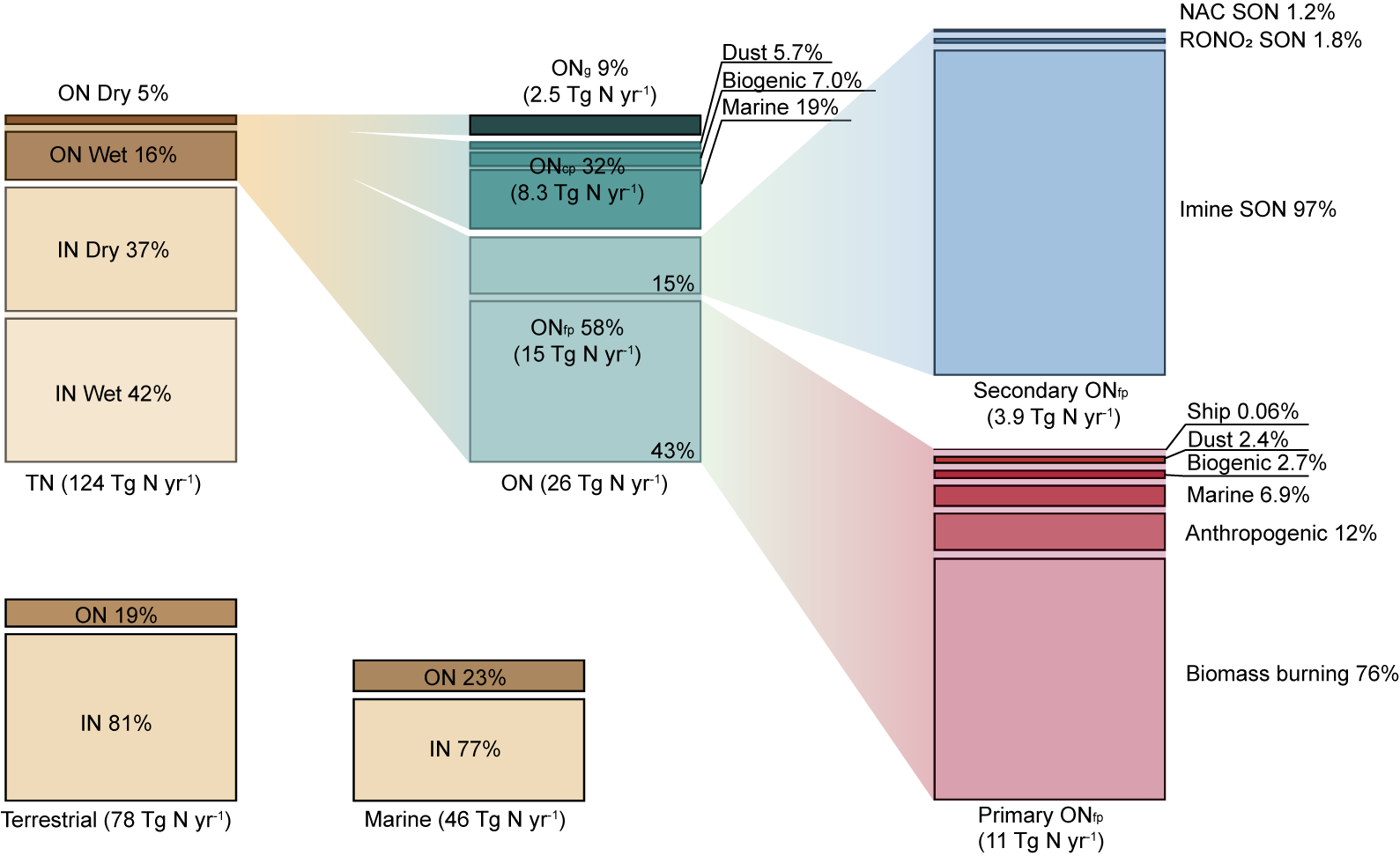
Figure 3. The global atmospheric total nitrogen (TN) deposition flux and the contributions of different N components as simulated by this study.
Dr. Yumin Li, a graduate of the SUSTech-HKUST joint Ph.D. program, is the first author of this paper. Professor Tzung-May Fu of SUSTech and Professor Jianzhen Yu of HKUST are the corresponding authors.
This work was supported by the National Natural Science Foundation of China (NSFC) and the Guangdong Basic and Applied Basic Research Foundation. Computational resources were provided by the Center for Computational Science and Engineering at SUSTech.
Paper link: https://doi.org/10.1093/nsr/nwad244
2026-03-10
2026-09-08
A delegation of 13 students from Southern University of Science and Technology (SUSTech), Zhejiang University and the University of Science and Technology of China (USTC), accompanied by four SUSTech faculty members including including two affiliated with the State Key Laboratory of Soil Pollution Control and Safety, concluded a 12-day summer school at Flinders University in August, 2026, hosted by the University’s National Centre for Groundwater Research and Training (NCGRT).Throughout the program, the students participated in a wide range of educational activities covering water resources, environmental health, groundwater modeling, managed aquifer recharge, salinity management, mining sites management, virtual reality hydrology, and nature-based solutions for surface water, groundwater and soil pollution.A highlight of the visit was a series of field trips showcasing South Australia’s unique natural environments. These included an overnight excursion to a global showcase of integrated surface and groundwater management exemplified by the Murray-Darling Basin. Visits to the St Kilda Mangroves highlighted ecohydrological approaches to coastal mangrove conservation. While Hallett Cove featured the most famous glacial striation on pre-Cambrian rocks. Happy Valley Reservoir, Oaklands Wetland, and Port Willunga Beach, with their wildlife, water management and well-exposed sedimentary rock formations, left strong impressions on our students. Students also attended research seminars and explored Flinders University’s teaching and research facilities.This summer school provided an excellent opportunity for students to engage with Flinders University staff, students, and researchers, experience Australian approaches to soil and groundwater pollution control and safety research, and strengthen the institutional ties between SUSTech and Flinders University, while fostering international connections and cross-cultural learning. The visit was made possible through a combination of support provided by SUSTech and the Fundamental and Interdisciplinary Disciplines Breakthrough Plan of the Ministry of Education of China(JYB2025XDXM909).During the visit, Chair Professor Yan ZHENG from SUSTech delivered a research seminar on arsenic detection in the developed and developing world. Flinders University noted that its academic community was privileged to learn from her expertise.SUSTech expresses its gratitude for the incredible partnership with Flinders University at the conclusion of the program.
2026-04-22
On April 22, the Frontiers Planet Prize announced its list of 25 National Champions for 2026. Hong WANG, a 2025 graduate of the School of Environmental Science and Engineering at the Southern Universi
2026-04-20
On the morning of April 17, 2026, a delegation from Flinders University (Australia), led by Professor Colin Stirling, President of Flinders University, visited the Southern University of Science and T
2026-04-08
Hydrological models are foundational tools for water resource management, agricultural planning, flood and drought mitigation, and ecosystem protection. A long-standing challenge in hydrology is devel
 |