

© 2026 All Rights Reserved. 粤ICP备14051456号
2023-02-03
View:14
Hydropower is a relatively cost-effective energy source, expected to play a key role in the transition of some nations to decarbonized energy systems. However, the development of hydropower is controversial because of its environmental and societal implications. Hydropower plants can disrupt river ecosystems, exacerbate flood risk, degrade land during construction, and displace people. It is still unclear how much hydropower can be developed in the world.
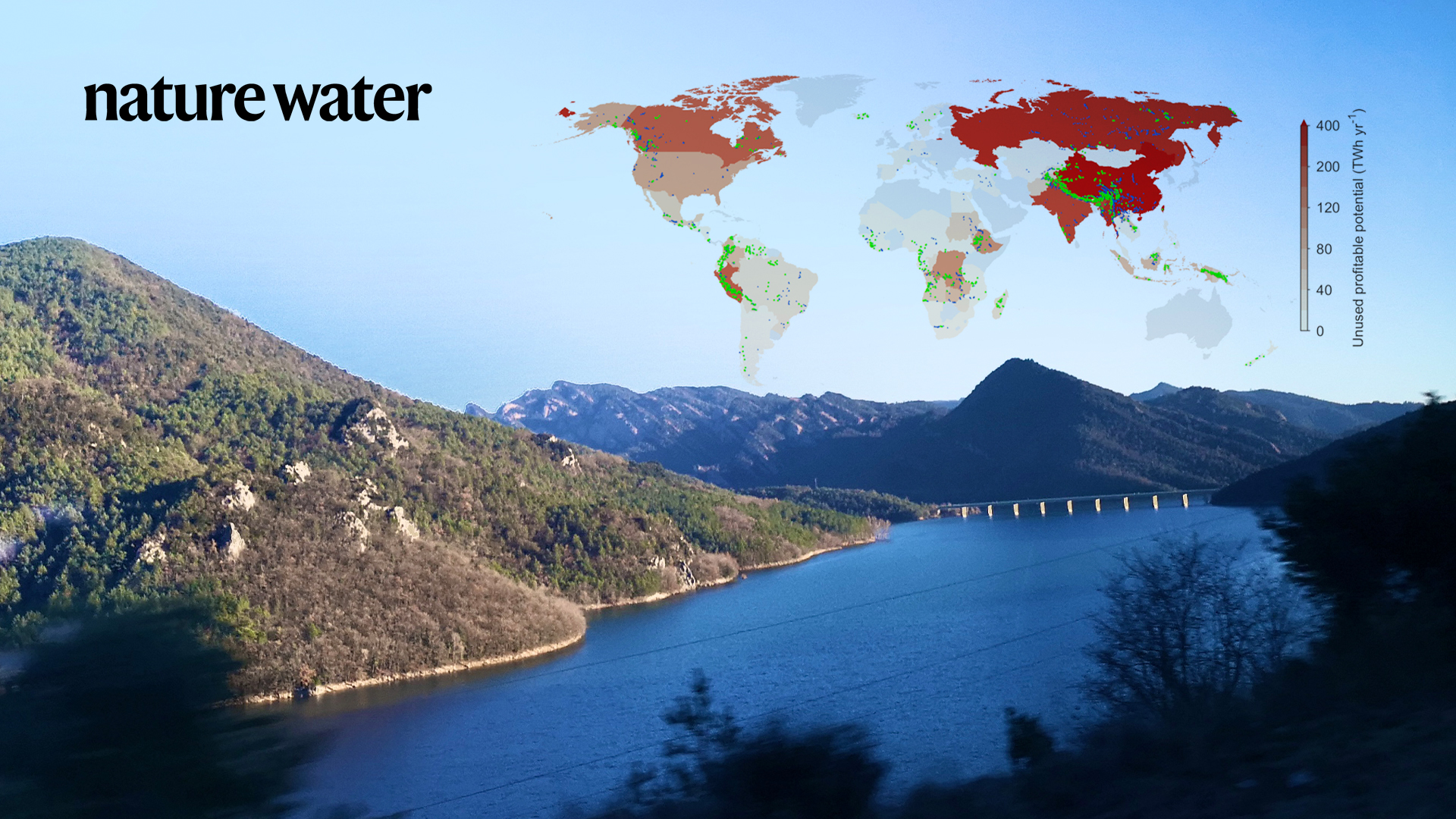
Associate Professor Zhenzhong Zeng’s research team from the School of Environmental Science and Engineering at the Southern University of Science and Technology (SUSTech) has recently analyzed the global unused hydropower potential of 2.89 million rivers worldwide. The authors synthesized river flow data, reservoir data, demographic and environmental variables, and cost considerations to determine locations where new hydropower plants could be established. Their analysis excludes sensitive locations, such as heritage areas, biodiversity hotspots, earthquake-prone zones, and densely populated regions, and considers how hydropower stations can maintain downstream river ecosystem integrity.
Their paper, entitled “A global-scale framework for hydropower development incorporating strict environmental constraints,” was published in Nature Water, a high-impact academic journal covering a broad range of disciplines about natural sciences and high-tech fields.
Prof. Zeng’s team indicated that the global unused profitable hydropower potential is 5.27 petawatt hours per year, and that Asia and Africa account for 85% of this total. They suggest that the most unused hydropower potential exists in Asia, with two-thirds of the global total located in the Himalayas. Africa’s unused hydropower potential ranks second, and the authors propose that most African countries, including the Democratic Republic of Congo, Ethiopia, the Republic of Sudan, South Sudan, Chad, Mauritania, the Republic of Niger, the Republic of Mali, Zambia, the Republic of Mozambique, Zimbabwe, Republic of Namibia, and Angola would be able to meet their current electricity demand if their unused profitable potential was developed.
Rongrong Xu, a Research Assistant Professor at SUSTech, said China has the highest existing hydropower production (~1.23 PWh in 2021); also has the world’s largest unused profitable potential. Potential development sites are concentrated mainly in the mountainous provinces of Tibet, Sichuan, Yunnan, and Guizhou (Fig. 1). This unused profitable potential hydropower of 2.25 PWh yr-1 could meet 30% of China’s current electricity demand of 7.19 PWh yr-1.
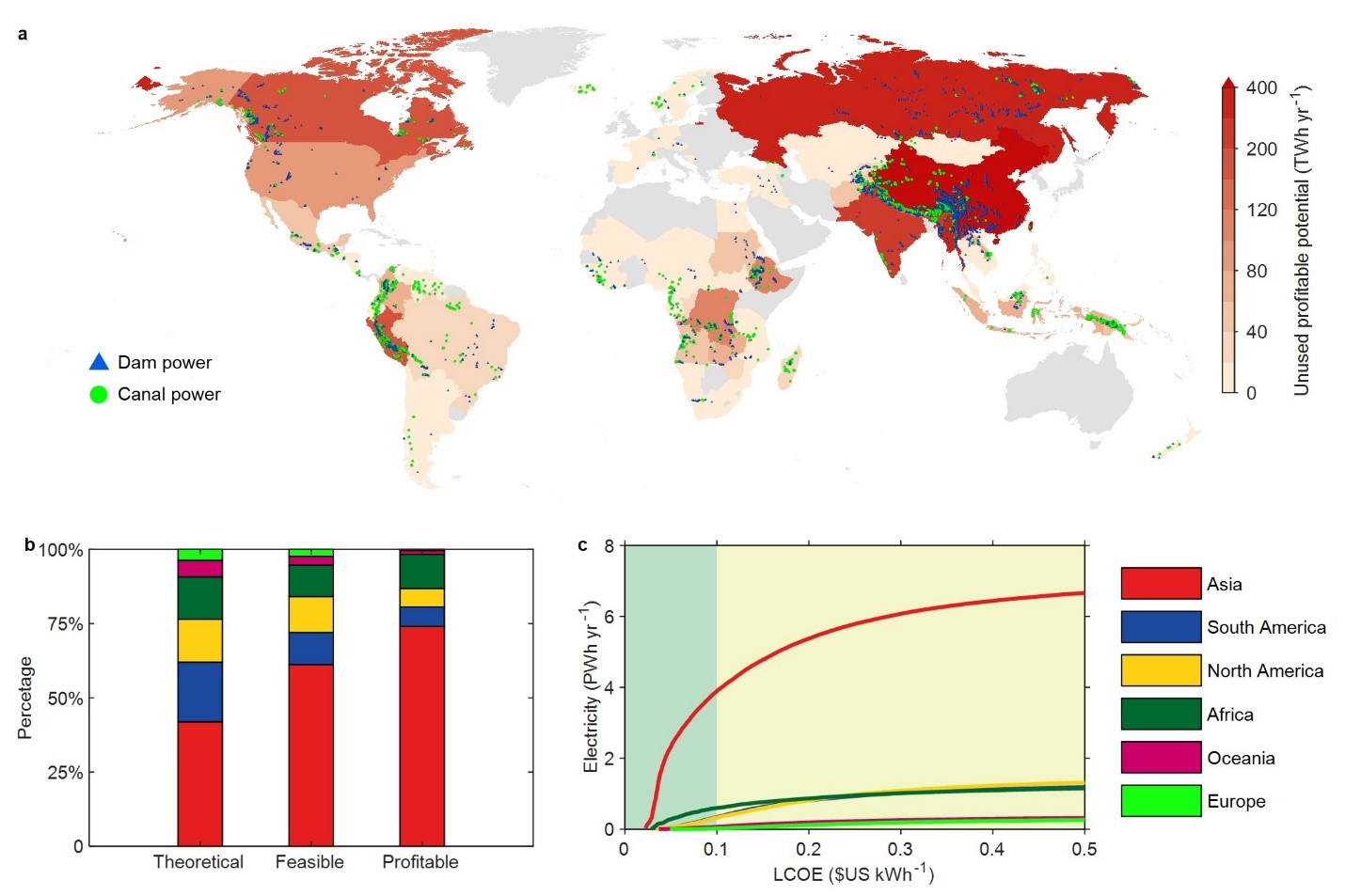
Figure 1. Spatial distribution and cost supply curve of unused profitable potential at the global and continental scales. (a) Spatial distribution of unused profitable potential. The profitable potential of each country is calculated based on the hydropower plant location. (b) Proportion of theoretical, feasible, and profitable potential of each continent. Both the feasible and profitable potentials account for environmental constraints. (c) Cost–supply curves of each continent.
Prof. Zeng’s team noted that their analysis offers a path to sustainably develop global hydropower, enabling hydropower to play a larger role in future energy resources while reducing negative impacts on the environment and societies.
Research Asst. Prof. Rongrong Xu is the first author of this paper. Assoc. Prof. Zhenzhong Zeng is the corresponding author. Other members from the SUSTech team included Prof. Chunmiao Zheng, Prof. Junguo Liu, Prof. Bin Ye, Dr. Dashan Wang, Ms. Xinyue He, and Mr. Junyu Zou.
Other researchers that contributed to this work included: Prof. Alan D. Ziegler of Mae Jo University; Prof. Ming Pan and Dr. Yuan Yang of the University of California San Diego; Prof. Lee E. Brown, Prof. Dominick V. Spracklenand and Prof. Joseph Holden of the University of Leeds; Prof. Deliang Chen of the University of Gothenburg; Prof. Haiwei Xu of Zhejiang University; Prof. Sonia Jerez of the University of Murcia; Prof. Peirong Lin of Peking University; Prof. Zongliang Yang of the University of Texas at Austin, Austin; Dr. Dongfeng Li of National University of Singapore; Prof. Junling Huang of China Three Gorges Corporation; Prof. Venkataraman Lakshmi of University of Virginia; Prof. Eric. F. Wood of Princeton University
This study was supported by the National Natural Science Foundation of China (NSFC) and the Start-Up Fund provided by SUSTech.
Paper link: https://www.nature.com/articles/s44221-022-00004-1
2026-03-10
2026-09-08
A delegation of 13 students from Southern University of Science and Technology (SUSTech), Zhejiang University and the University of Science and Technology of China (USTC), accompanied by four SUSTech faculty members including including two affiliated with the State Key Laboratory of Soil Pollution Control and Safety, concluded a 12-day summer school at Flinders University in August, 2026, hosted by the University’s National Centre for Groundwater Research and Training (NCGRT).Throughout the program, the students participated in a wide range of educational activities covering water resources, environmental health, groundwater modeling, managed aquifer recharge, salinity management, mining sites management, virtual reality hydrology, and nature-based solutions for surface water, groundwater and soil pollution.A highlight of the visit was a series of field trips showcasing South Australia’s unique natural environments. These included an overnight excursion to a global showcase of integrated surface and groundwater management exemplified by the Murray-Darling Basin. Visits to the St Kilda Mangroves highlighted ecohydrological approaches to coastal mangrove conservation. While Hallett Cove featured the most famous glacial striation on pre-Cambrian rocks. Happy Valley Reservoir, Oaklands Wetland, and Port Willunga Beach, with their wildlife, water management and well-exposed sedimentary rock formations, left strong impressions on our students. Students also attended research seminars and explored Flinders University’s teaching and research facilities.This summer school provided an excellent opportunity for students to engage with Flinders University staff, students, and researchers, experience Australian approaches to soil and groundwater pollution control and safety research, and strengthen the institutional ties between SUSTech and Flinders University, while fostering international connections and cross-cultural learning. The visit was made possible through a combination of support provided by SUSTech and the Fundamental and Interdisciplinary Disciplines Breakthrough Plan of the Ministry of Education of China(JYB2025XDXM909).During the visit, Chair Professor Yan ZHENG from SUSTech delivered a research seminar on arsenic detection in the developed and developing world. Flinders University noted that its academic community was privileged to learn from her expertise.SUSTech expresses its gratitude for the incredible partnership with Flinders University at the conclusion of the program.
2026-04-22
On April 22, the Frontiers Planet Prize announced its list of 25 National Champions for 2026. Hong WANG, a 2025 graduate of the School of Environmental Science and Engineering at the Southern Universi
2026-04-20
On the morning of April 17, 2026, a delegation from Flinders University (Australia), led by Professor Colin Stirling, President of Flinders University, visited the Southern University of Science and T
2026-04-08
Hydrological models are foundational tools for water resource management, agricultural planning, flood and drought mitigation, and ecosystem protection. A long-standing challenge in hydrology is devel
 |