

© 2026 All Rights Reserved. 粤ICP备14051456号
2025-06-20
View:31
In recent years, the growing environmental pressures from increasing global meat consumption have become increasingly prominent. Livestock farming currently provides about a quarter of global human protein intake, occupies over 30% of land resources, and contributes substantially to greenhouse gas emissions and water pollution. In many regions—especially where intensive livestock farming is concentrated—nitrate concentrations in groundwater have significantly exceeded natural levels, threatening drinking water safety and posing a serious challenge to the achievement of the Sustainable Development Goals (SDGs).

A research team led by Associate Professor Zhilin Guo from the School of Environmental Science and Engineering at the Southern University of Science and Technology (SUSTech) has systematically revealed the long-term impact of conventional meat production on groundwater pollution. Their study suggests that moderate adjustments in dietary protein sources could significantly improve groundwater quality, providing a new pathway for achieving the SDGs.
Their paper, titled “Changes in meat consumption can improve groundwater quality”, has been published in Nature Food.
Using the United States (U.S.) as a case study, the researchers assessed the relationship between meat consumption and groundwater nitrate pollution from 1985 to 2020. Their analysis showed that the impact of livestock farming on groundwater pollution has been steadily increasing and, in some years, has surpassed that of traditional crop agriculture. With the continued expansion of the livestock industry, its influence on groundwater quality is projected to become even more pronounced.
In scenario modeling, the team simulated a 10% reduction in conventional meat intake, with the protein gap filled by alternatives such as plant-based proteins (e.g., legumes), novel animal sources (e.g., insects), and biotech innovations (e.g., cultured meat or fungal proteins). The results indicated that such a substitution strategy could reduce nitrogen fertilizer use by 3.4%, manure production by 10.7%, and water usage by 4.5%. More notably, it could lower the risk of groundwater nitrate exceedance (nitrate concentration >10 mg/L) by nearly 20%. Despite the modest substitution rate, the environmental benefits are substantial—demonstrating a “small change, big impact” potential in pollution mitigation.
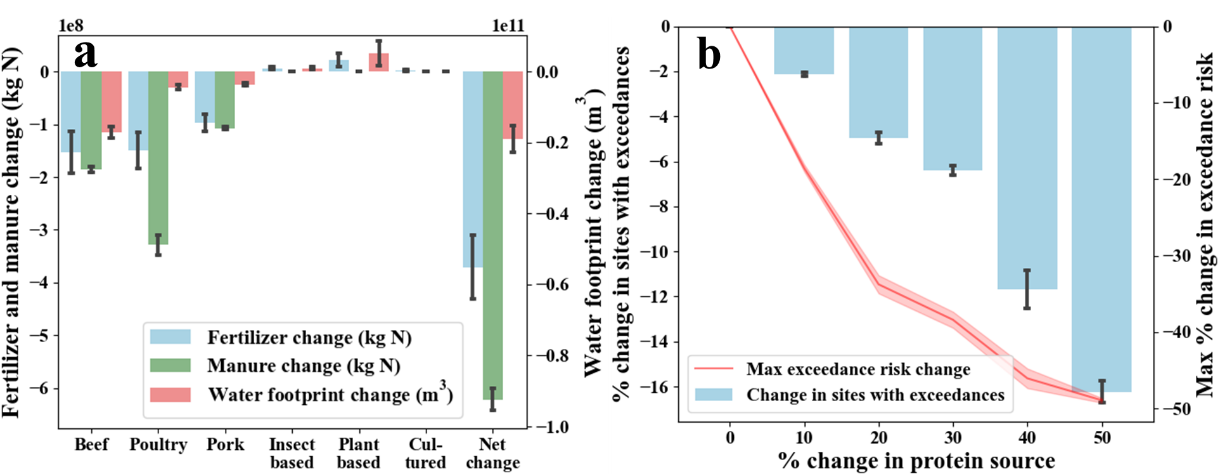
Figure 1. Impacts of protein source transition on (a) nitrogen fertilizer, manure, and water footprint, and (b) groundwater nitrate levels
The study also highlights the spatial heterogeneity of these benefits. In the U.S., states like Texas and Iowa account for roughly one-third of the national livestock inventory. Implementing reductions in these high-density farming regions could yield disproportionately large environmental improvements, with positive benefits extending to feed production areas and beyond. For countries such as China and India—where meat demand is rising rapidly, livestock density is high, and nitrogen use efficiency in agriculture remains low—these findings are particularly relevant.
The team’s findings demonstrate that guiding dietary transitions in a scientifically informed and regionally adaptive manner can meet nutritional needs while significantly reducing agricultural pressures on groundwater systems. This offers valuable support for agricultural green transformation, high-quality water environment development, and the coordinated realization of multiple sustainability targets—including clean water, climate action, and biodiversity conservation.
Dr. Yang Zhan is the first author of the paper. Associate Professor Zhilin Guo is the corresponding author, with SUSTech serving as the first affiliated institution. Other co-authors include Dr. Joel Podgorski from the Swiss Federal Institute of Aquatic Science and Technology (Eawag); Associate Professor Peng Xu from Tianjin University; Liqing Peng from the World Resources Institute; Professor Vladan Babovic from the National University of Singapore; and Chair Professor Chunmiao Zheng from SUSTech.
Paper link: https://www.nature.com/articles/s43016-025-01188-x
2026-03-10
2026-09-08
A delegation of 13 students from Southern University of Science and Technology (SUSTech), Zhejiang University and the University of Science and Technology of China (USTC), accompanied by four SUSTech faculty members including including two affiliated with the State Key Laboratory of Soil Pollution Control and Safety, concluded a 12-day summer school at Flinders University in August, 2026, hosted by the University’s National Centre for Groundwater Research and Training (NCGRT).Throughout the program, the students participated in a wide range of educational activities covering water resources, environmental health, groundwater modeling, managed aquifer recharge, salinity management, mining sites management, virtual reality hydrology, and nature-based solutions for surface water, groundwater and soil pollution.A highlight of the visit was a series of field trips showcasing South Australia’s unique natural environments. These included an overnight excursion to a global showcase of integrated surface and groundwater management exemplified by the Murray-Darling Basin. Visits to the St Kilda Mangroves highlighted ecohydrological approaches to coastal mangrove conservation. While Hallett Cove featured the most famous glacial striation on pre-Cambrian rocks. Happy Valley Reservoir, Oaklands Wetland, and Port Willunga Beach, with their wildlife, water management and well-exposed sedimentary rock formations, left strong impressions on our students. Students also attended research seminars and explored Flinders University’s teaching and research facilities.This summer school provided an excellent opportunity for students to engage with Flinders University staff, students, and researchers, experience Australian approaches to soil and groundwater pollution control and safety research, and strengthen the institutional ties between SUSTech and Flinders University, while fostering international connections and cross-cultural learning. The visit was made possible through a combination of support provided by SUSTech and the Fundamental and Interdisciplinary Disciplines Breakthrough Plan of the Ministry of Education of China(JYB2025XDXM909).During the visit, Chair Professor Yan ZHENG from SUSTech delivered a research seminar on arsenic detection in the developed and developing world. Flinders University noted that its academic community was privileged to learn from her expertise.SUSTech expresses its gratitude for the incredible partnership with Flinders University at the conclusion of the program.
2026-04-22
On April 22, the Frontiers Planet Prize announced its list of 25 National Champions for 2026. Hong WANG, a 2025 graduate of the School of Environmental Science and Engineering at the Southern Universi
2026-04-20
On the morning of April 17, 2026, a delegation from Flinders University (Australia), led by Professor Colin Stirling, President of Flinders University, visited the Southern University of Science and T
2026-04-08
Hydrological models are foundational tools for water resource management, agricultural planning, flood and drought mitigation, and ecosystem protection. A long-standing challenge in hydrology is devel
 |