

© 2026 All Rights Reserved. 粤ICP备14051456号
2025-08-18
View:31
Intensifying climate change has led to increasingly frequent extreme flood events worldwide, posing serious threats to human society. According to the latest data from the United Nations Office for Disaster Risk Reduction, the frequency of catastrophic flood disasters globally has surged by 134% since the beginning of this century, causing over 100,000 deaths and direct economic losses exceeding $651 billion.
Traditional rainfall-runoff models often tend to underestimate peak flows and struggle to forecast the most dangerous and destructive flood surges. They are also unable to directly provide probability-based risk assessments, an important capability for disaster preparedness and response.
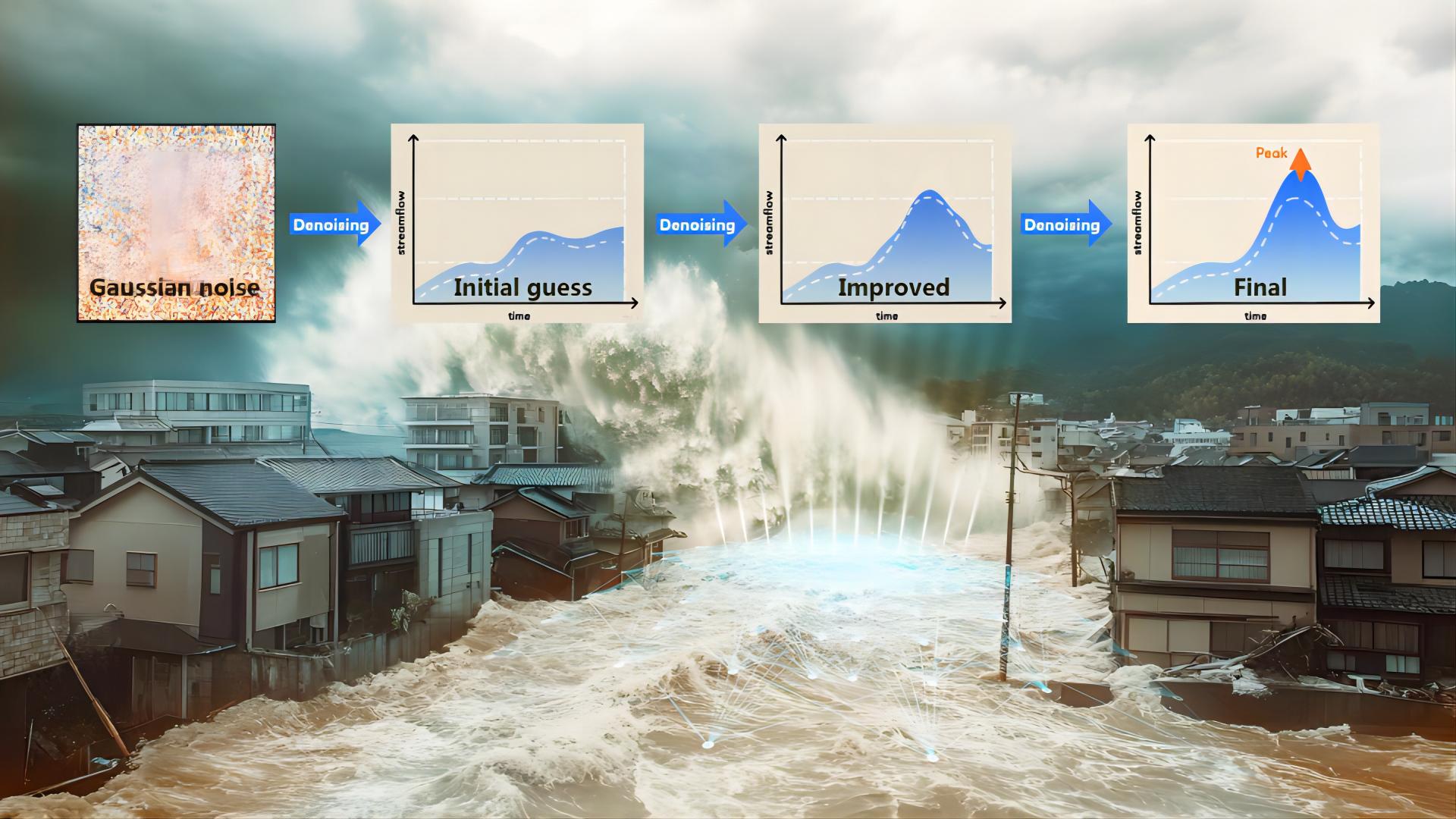
Professor Yi Zheng’s research group from the School of Environmental Science and Engineering at the Southern University of Science and Technology (SUSTech), in collaboration with the Institute of Atmospheric Physics, Chinese Academy of Sciences (CAS), and other institutions, has achieved a breakthrough by successfully applying diffusion models—a cutting-edge generative artificial intelligence (GAI) technology—to flood forecasting for the first time. Their study not only brings revolutionary advances to flood forecasting technology but also explores new pathways for AI applications in hydrology and the broader Earth system sciences.
Their findings, titled “Probabilistic Diffusion Models Advance Extreme Flood Forecasting,” have been published in the journal Geophysical Research Letters.
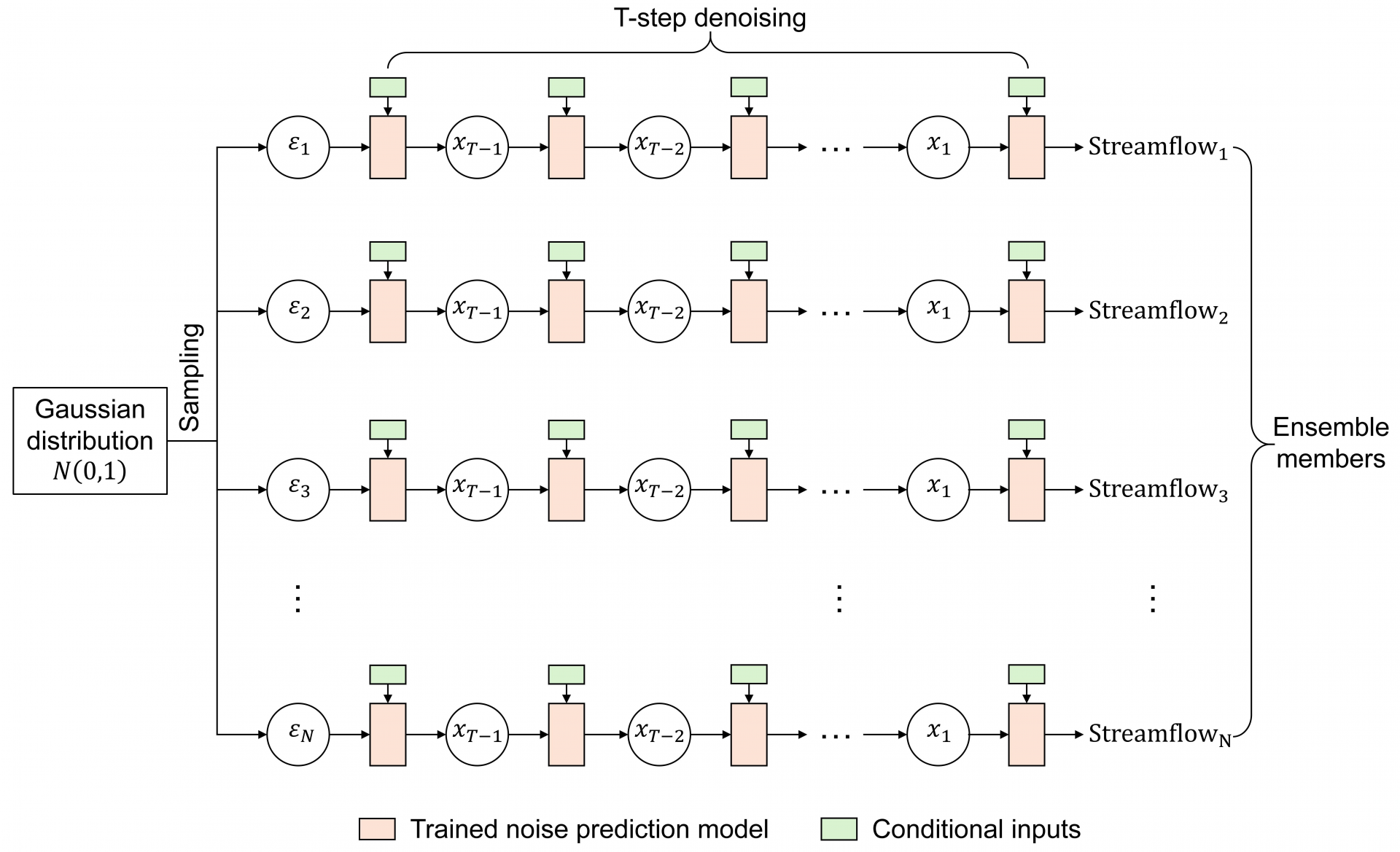
The researchers introduced the diffusion-based runoff model (DRUM) method based on diffusion models, which uses deep neural networks to train noise models with runoff data. These models are employed in multi-step denoising operations to generate ensemble forecast data for runoff (Figure 1). DRUM does not require predefined probability distribution forms for runoff; instead, it learns the probability distributions directly from the data. It can accomplish multi-scale task decomposition, breaking down complex flood forecasting tasks into a series of relatively simple sub-tasks, and features flexible conditional generation mechanisms that can effectively utilize conditional information, such as meteorological conditions associated with flood formation. These characteristics enable DRUM to effectively handle the nonlinear, multi-scale, and highly uncertain characteristics in flood forecasting.
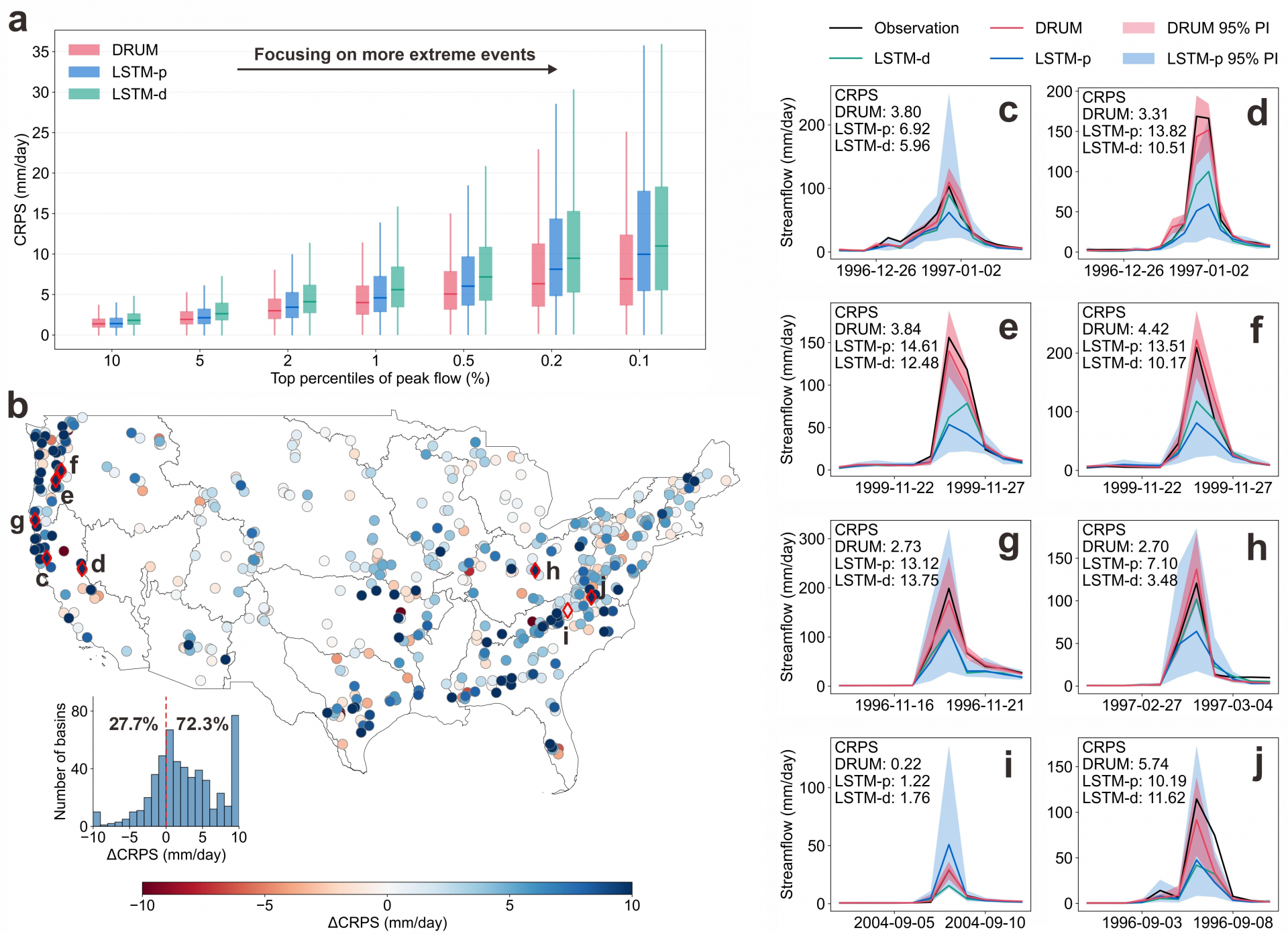
The team validated DRUM’s performance using the CAMELS dataset on 531 representative basins across the United States and compared it with existing deep learning benchmark models. For nowcasting (0-day lead time), DRUM’s accuracy gains increased with flood magnitude (Figure 2a). In 72.3% of the studied basins, it surpassed the benchmark model in predicting the top 0.1% of flows—the most extreme floods (Figure 2b). Furthermore, DRUM’s advantages in probabilistic flood forecasting were further highlighted in eight extreme flood events that exceeded historical data maxima (Figure 2c-j).
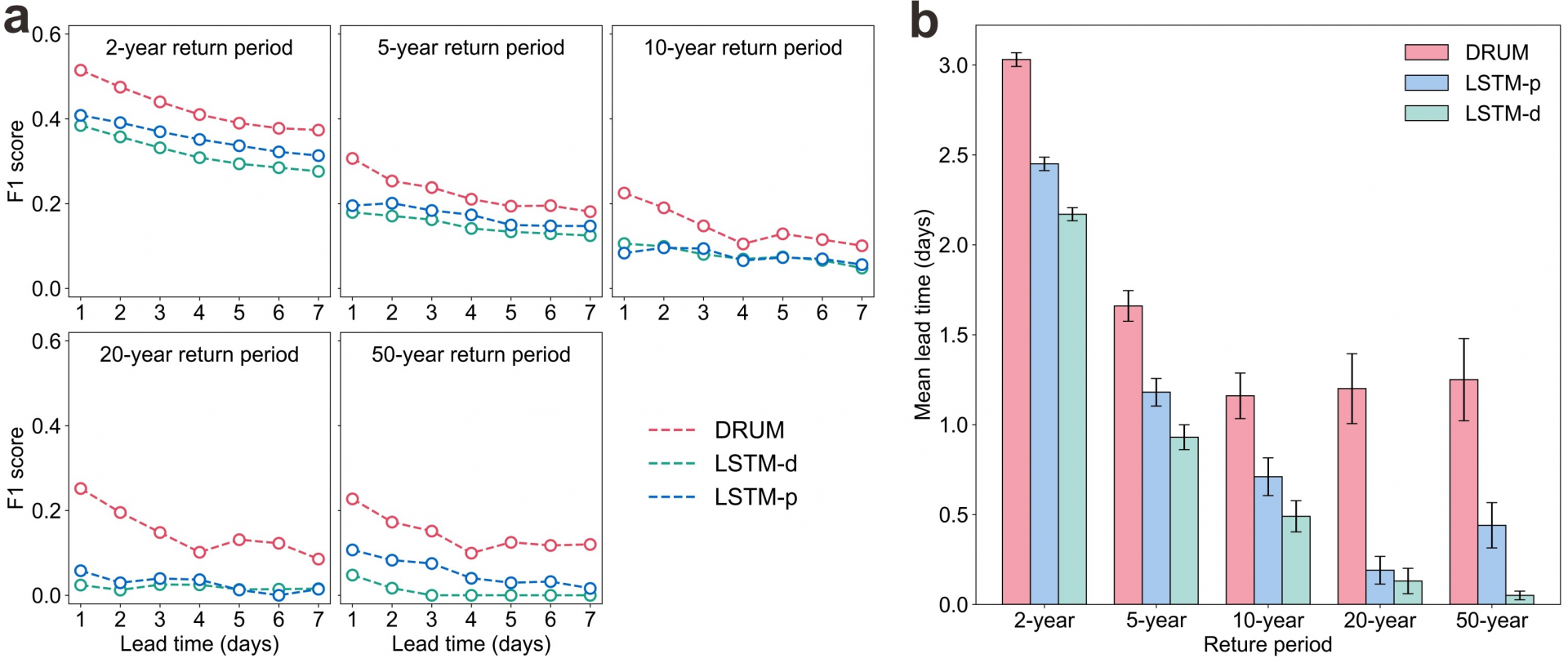
Using precipitation forecast data from the European Centre for Medium-Range Weather Forecasts Integrated Forecasting System (ECMWF-IFS), the researchers extended DRUM from nowcasting to operational forecasting with a 7-day lead time. Results showed that DRUM consistently outperformed benchmark methods across various flood magnitudes and different lead times (Figure 3a), while also demonstrating superior flood early warning capabilities (Figure 3b), particularly for extreme events such as 20-year and 50-year return period floods. Notably, it successfully increased the average early warning lead time from approximately 0.2 days to about 1.2 days, achieving nearly a full day’s improvement.
This work fully demonstrates the bright prospects of using generative artificial intelligence for operational flood forecasting, with significant implications for global flood risk assessment, early warning, and emergency response.
Doctoral student Zhigang Ou from the School of Environmental Science and Engineering at SUSTech and Congyi Nai from the Institute of Atmospheric Physics, CAS, are co-first authors of the paper. Professor Yi Zheng and Associate Professor Baoxiang Pan from the Institute of Atmospheric Physics, CAS, serve as co-corresponding authors, with SUSTech as the first affiliated institution.
Other collaborators include Professor Chaopeng Shen from Pennsylvania State University, Assistant Professor Peishi Jiang from Pacific Northwest National Laboratory, Associate Professor Xingcai Liu and Professor Qiuhong Tang from the Institute of Geographic Sciences and Natural Resources Research, CAS, doctoral student Wenqing Li from the China Institute of Water Resources and Hydropower Research, and Professor Ming Pan from the University of California, San Diego.
Paper link: https://doi.org/10.1029/2025GL115705
2026-03-10
2026-09-08
A delegation of 13 students from Southern University of Science and Technology (SUSTech), Zhejiang University and the University of Science and Technology of China (USTC), accompanied by four SUSTech faculty members including including two affiliated with the State Key Laboratory of Soil Pollution Control and Safety, concluded a 12-day summer school at Flinders University in August, 2026, hosted by the University’s National Centre for Groundwater Research and Training (NCGRT).Throughout the program, the students participated in a wide range of educational activities covering water resources, environmental health, groundwater modeling, managed aquifer recharge, salinity management, mining sites management, virtual reality hydrology, and nature-based solutions for surface water, groundwater and soil pollution.A highlight of the visit was a series of field trips showcasing South Australia’s unique natural environments. These included an overnight excursion to a global showcase of integrated surface and groundwater management exemplified by the Murray-Darling Basin. Visits to the St Kilda Mangroves highlighted ecohydrological approaches to coastal mangrove conservation. While Hallett Cove featured the most famous glacial striation on pre-Cambrian rocks. Happy Valley Reservoir, Oaklands Wetland, and Port Willunga Beach, with their wildlife, water management and well-exposed sedimentary rock formations, left strong impressions on our students. Students also attended research seminars and explored Flinders University’s teaching and research facilities.This summer school provided an excellent opportunity for students to engage with Flinders University staff, students, and researchers, experience Australian approaches to soil and groundwater pollution control and safety research, and strengthen the institutional ties between SUSTech and Flinders University, while fostering international connections and cross-cultural learning. The visit was made possible through a combination of support provided by SUSTech and the Fundamental and Interdisciplinary Disciplines Breakthrough Plan of the Ministry of Education of China(JYB2025XDXM909).During the visit, Chair Professor Yan ZHENG from SUSTech delivered a research seminar on arsenic detection in the developed and developing world. Flinders University noted that its academic community was privileged to learn from her expertise.SUSTech expresses its gratitude for the incredible partnership with Flinders University at the conclusion of the program.
2026-04-22
On April 22, the Frontiers Planet Prize announced its list of 25 National Champions for 2026. Hong WANG, a 2025 graduate of the School of Environmental Science and Engineering at the Southern Universi
2026-04-20
On the morning of April 17, 2026, a delegation from Flinders University (Australia), led by Professor Colin Stirling, President of Flinders University, visited the Southern University of Science and T
2026-04-08
Hydrological models are foundational tools for water resource management, agricultural planning, flood and drought mitigation, and ecosystem protection. A long-standing challenge in hydrology is devel
 |