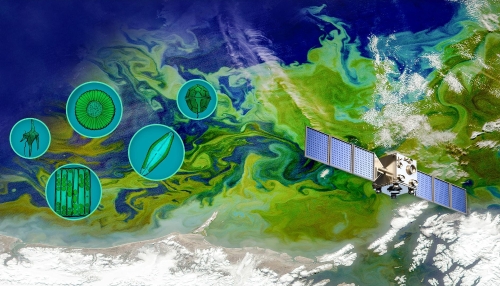
Recently, Associate professor at the Southern University of Science and Technology (SUSTech) Lian Feng’s research group published a research paper entitled "Coastal phytoplankton blooms expand and intensify in the 21st century" in Nature. The paper was selected as the cover article of the issue. The study reveals the overall increasing trend of global coastal phytoplankton blooms from 2003 to 2020, and quantifies the potential relationship between the frequency of blooms and sea surface temperature (SST), ocean mesoscale circulation, and human activities such as agricultural fertilizer application and aquaculture.Figure 1. Cover of NaturePhytoplankton are microalgae that live planktonically in the water and form algal blooms (or red tides) when large numbers of algal cells gather together. Outbreaks of algal blooms can endanger marine ecosystems, such as deterioration of seawater quality, lack of oxygen in the water, death of fish, and can even affect human health. Currently, marine red tide has become one of the most serious problems affecting marine ecosystems. However, the spatial and temporal dynamics of coastal algal blooms cannot be accurately described on a global scale based on existing in situ measurement data. This study takes advantage of the long time series, periodicity and large scale of observation by satellite remote sensing to bridge the gap in the current knowledge of global coastal phytoplankton bloom trends.The research team constructed a remote sensing fully automated classification algorithm for coastal algal blooms, and used the 760,000 scene-per-day US MODIS satellite remote sensing data from 2003 to 2020 to achieve consistent dynamic monitoring of global coastal algal blooms. Of the 153 sea-adjacent countries covered in the study, 126 countries experienced phytoplankton blooms in coastal areas (Figure 2). The total area of the global coastal zone affected by algal blooms was 31.47 million km2, of which Europe and North America are the top two, 9.52 million km2 (30.3%) and 6.78 million km2 (21.5%), respectively.Figure 2. Global patterns of coastal phytoplankton blooms between 2003 and 2020. a, The spatial distribution of annual mean bloom count based on daily satellite detections. b, Continental and global statistics for annual mean bloom count (SA: South America, AF: Africa, EU: Europe, NA: North America, AS: Asia, AU: Australia). c, Continental statistics for the long-term annual mean of bloom-affected areas. The percentages show the corresponding contributions to the global total.From 2003 to 2020, the global bloom-affected area and bloom frequency increased by 13.2% and 59.2%, respectively (Figure 3). Globally, the frequency of algal blooms increased the most in six major coastal current systems, including the Oyashio, Alaska Current, Canary Current, Malvinas Current, Gulf Stream, and Benguela Current. At low latitudes (south of 30°N) in the northern hemisphere, algal blooms showed a weakening trend, such as in the California Current and the Arabian Sea; algal blooms in the northern Gulf of Mexico and the southeast China coastal region showed an increasing trend. At high latitudes, the weakening of algal blooms occurred mainly in the northeastern waters of the North Atlantic Ocean and in the Sea of Okhotsk in the northwestern North Pacific Ocean. In addition, the frequency of algal blooms showed an increasing trend in almost the whole southern hemisphere.Figure 3. Trends of global coastal phytoplankton blooms between 2003 and 2020. a, Spatial patterns of the trends in bloom frequency at a 1° × 1° grid scale. b, Interannual variability and trends in annual median bloom frequency and total global bloom-affected area.Changes in ocean temperature and circulation can alter the ocean stratification state and nutrient transport, which then affect phytoplankton growth and algal bloom formation. The study analyzed the correlation between phytoplankton bloom frequency, SST, SST gradient (▽SST, used to characterize the strength of ocean mesoscale currents) (Figure 4). The results showed that there was a significant positive correlation between the annual mean algal bloom frequency and the contemporaneous SST in high latitudes (north of 40°N), such as the Alaska Current, Oyashio, and Baltic Sea. The trends of algal bloom frequency and SST were not consistent in many seas, for example, the tropical and subtropical areas of diminished algal bloom.Further analysis showed that the SST gradient showed a more significant positive correlation with the frequency of phytoplankton blooms, such as the Canary Current, Malvinas Current, California Current, Benguela Current, and Gulf Stream. In addition, the trend of bloom frequency in the subtropical eastern boundary upwelling region is consistent with the variability of mesoscale currents (California, Benguela, and Canary Currents). In the California Current system, the reduced bloom frequency may be due to the weakened upwelling (manifested by the decrease of ▽SST and increase of SST), which leads to the decrease of benthic nutrient supply. In contrast, the Canary and Benguela Currents are characterized by enhanced upwelling and increased bloom frequency. Although the upwelling of the two western boundary current systems (Malvinas and Oyashio) in high latitudes is less pronounced, the change mechanism of their algal blooms is similar to that in the subtropical eastern boundary regions. However, further regional studies are needed to determine whether changes in mesoscale ocean currents are affected by other factors such as wind, ocean stratification, and ocean current shear.Figure 4. Effects of climate change on phytoplankton blooms. a,b, Global patterns of trends in SST gradient (a) and SST (b) from 2003 to 2020. c, Longterm changes in bloom frequency in the regions labelled in a and b, and their relationship to the SST and SST gradient. Linear slope (S) of bloom frequency and the correlation coefficient (r) between bloom frequency and the SST and the SST gradient (∇SST) are shown. Asterisks indicate statistically significant (P < 0.05) correlations.The analysis shows that global climate extremes also have a certain impact on global coastal phytoplankton blooms. Taking the Multivariate El Niño–Southern Oscillation (ENSO) index (MEI) as an example, the lowest MEI (a strong La Niña year) in 2010 corresponds to the frequency of low bloom frequency in the following year, while in 2015 The largest MEI values (strong El Niño years) were accompanied by the highest frequency of bloom frequency in the following year.Changes in anthropogenic nutrient enrichment may have also contributed to the trends in blooms. For example, the decline in bloom frequency in the Arabian Sea may be related to reduced fertilizer use in neighboring countries such as Iran. In addition, increases in algal blooms in many Asian countries may be attributed to a surge in fertilizer use. For example, fertilizer use (nitrogen or phosphorus) was highly positively correlated with bloom frequency in countries such as China, Iran, Vietnam, and the Philippines. In addition, aquaculture production in Finland, China, Algeria, Guinea, Vietnam, Argentina, Russia, and Uruguay were significantly positively correlated with the bloom frequency. However, further attribution and mechanistic analysis of natural and anthropogenic factors on bloom trends requires consideration of complex terrestrial/marine nutrient transport processes and the construction of ecological models coupling nutrient and phytoplankton growth relationships of different algal species for assessment. Yanhui Dai, a PhD student at Southern University of Science and Technology, and Shangbo Yang, a postdoctoral fellow, are the co-first authors of the paper, Associate Professor Lian Feng is the sole corresponding author, and SUSTech is the only first and corresponding unit of the paper. Co-authors include Ph.D. student Zhao Dan from the School of Environmental Science and Engineering of Southern University of Science and Technology, Associate Professor Luke Gibson, Chair Professor Chunmiao Zheng, Dr. Wang Xu from Shenzhen Ecological Environment Monitoring Center, Guangdong Province, Professor Chuanmin Hu from the University of South Florida, USA, and Woods Hole, USA Professor Donald M. Anderson from the Institute of Oceanography, Dr. Yun Li from the University of Delaware, Dr. Xiaopeng Song from the University of Maryland, and Dr. Daniel G. Boyce from the Bedford Institute of Oceanography, Canada. Paper link: https://www.nature.com/articles/s41586-023-05760-y










[-]30091030_80536.jpg)

[-]30091011_91673.jpg)














 |